Living Museum of Learning
Reality Edited the Exhibit
Situation
The morning began with a tiny scheduling puzzle.
Cloud wrote:
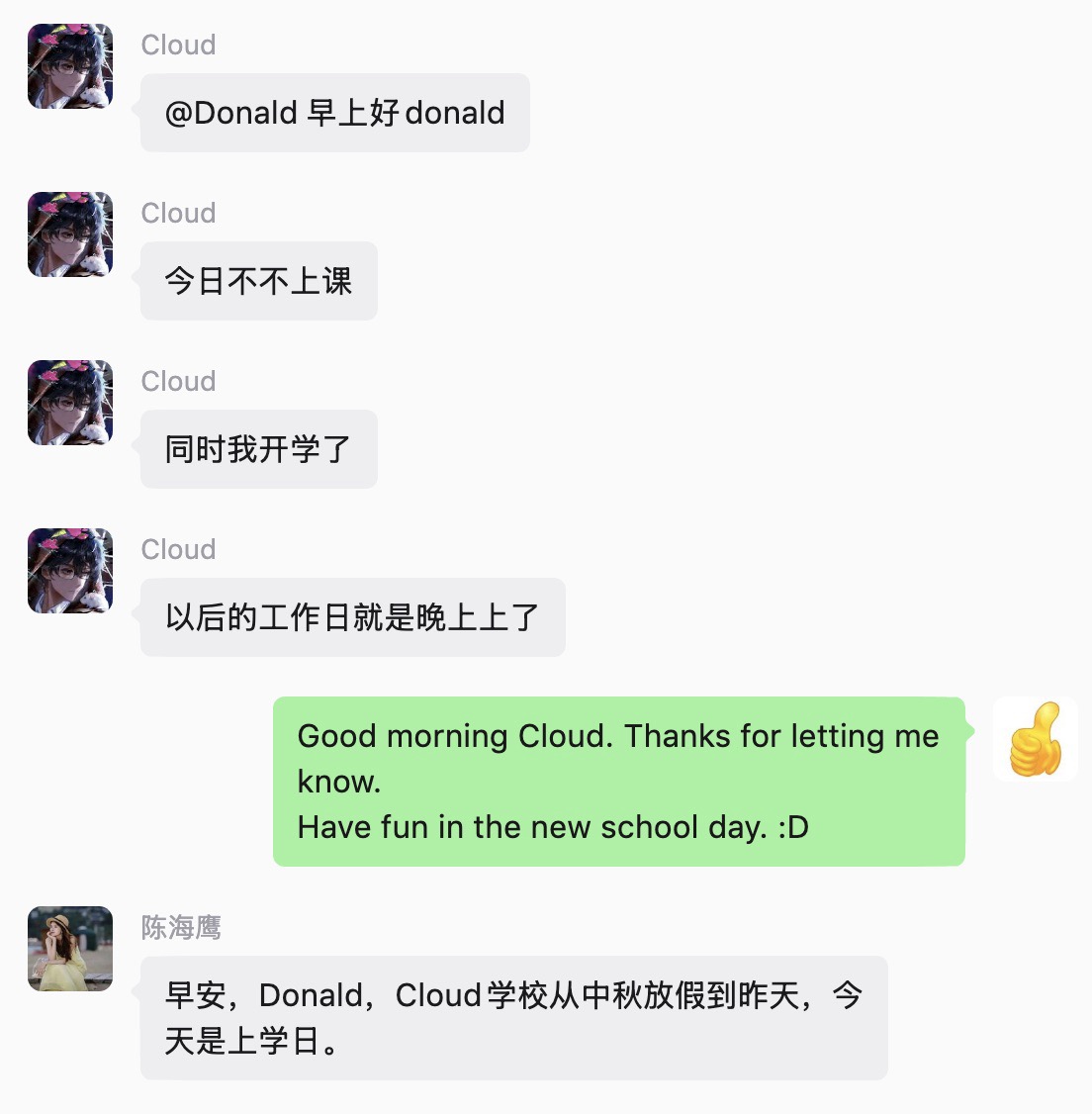
“今日不不上课”
Today we don't not have class.
Then he added:
“同时我开学了”
At the same time, school has started.
Because it was Monday and school had started, Donald naturally interpreted this as: no morning class anymore, so perhaps the regular weekday class would move to the evening.
Cloud’s mother later clarified that it was simply a school day—and that there was actually a school activity that evening.
Unfortunately, that last piece of information had not been included in the original message. 😂
Donald decided to make the safest assumption:
“从数学意义上理解,Cloud 的表述是严密的,没有逻辑问题。”
From a mathematical point of view, Cloud’s wording is logically sound.
“不能上课,咱们也不损失。比因为误解而缺课好多了。”
If we can't have class, we don't lose anything. That's much better than missing class because of a misunderstanding.
So Donald started writing an exhibit called “Today We Don't Have Class.”
Turning Point
Then, at 7:39 p.m., Cloud came home.
“我刚回到家”
I just got home.
And then:
“请问还来得及上课吗”
Is it still possible to have class?
Donald:
“没问题”
No problem.
😂
The exhibit title had just become obsolete.
Reality edited the exhibit.
The Class That Wasn't Supposed to Happen
Cloud had a test the next day, so most of the class turned into trigonometry.
Donald pushed three little words into Cloud’s brain with all his strength:
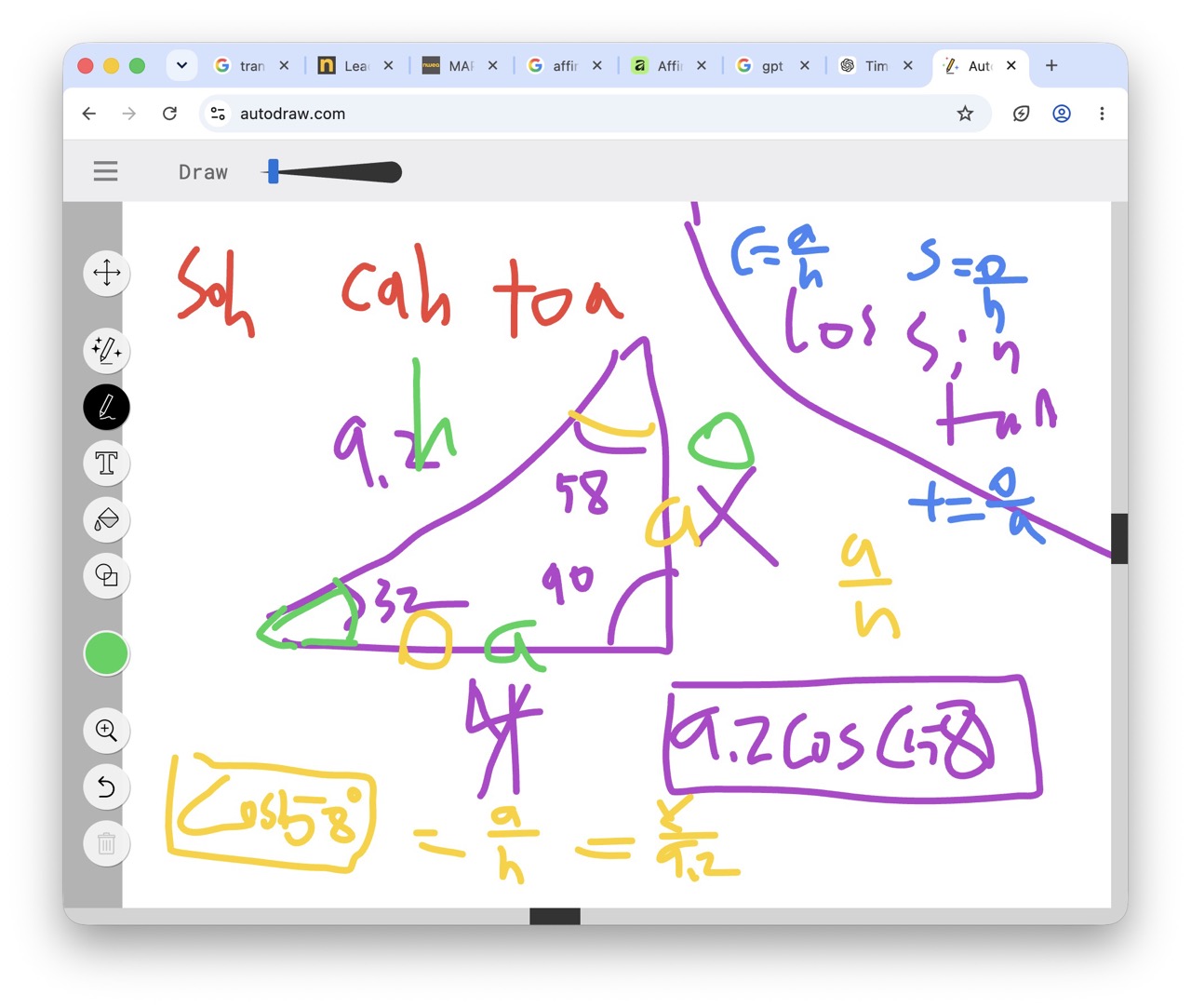
SOH CAH TOA.
And Cloud’s brain immediately started spinning:
This angle? That angle? Which side is a? Where is o? Where is h? Did I flip something?
Unlike probability, however, Donald discovered that trig was extremely easy to turn into a game.
Cloud brought another problem from memory:
h = 9.2, with angles 58° and 32°.
He slowly worked through SOH CAH TOA and got 4.88 for one side.
Then something wonderful happened.
Using the newly learned trigonometry, he calculated another side and got 7.8—almost immediately.
“Is That Correct?”
Cloud wasn't sure.
“Is that correct?”
Donald didn't simply tell him.
“It could be right. You see. It is longer than the other side in your diagram.”
There was already a geometric sanity check: the number looked reasonable because that side was visibly longer.
But Donald had something even better.
“But we have a great way to verify it. Pythagorean theorem!”
And Cloud was hooked.
He verified the answer.
Then he verified it again, from the other direction.
😂
Emergence
Something had changed.
At the beginning of the trig lesson, Cloud's mind was busy trying to remember which letter belonged to which side.
By the end, he was doing something much more powerful:
He was using mathematics to check mathematics.
The answer wasn't trusted because Donald said it was right.
It was trusted because Cloud found another mathematical path that led back to it.
The School Test
Earlier that day, Cloud had encountered a similar problem on a tiny school quiz.
He had chosen an answer involving a square root in the denominator.
During our class, after simplifying a related expression, he suddenly realized what had happened.
“Ah. I selected one with √3 at bottom in today's school test. But it's just a tiny quiz, not a big deal.”
Donald didn't turn the mistake into a disaster.
Instead, the mistake had become tonight's lesson.
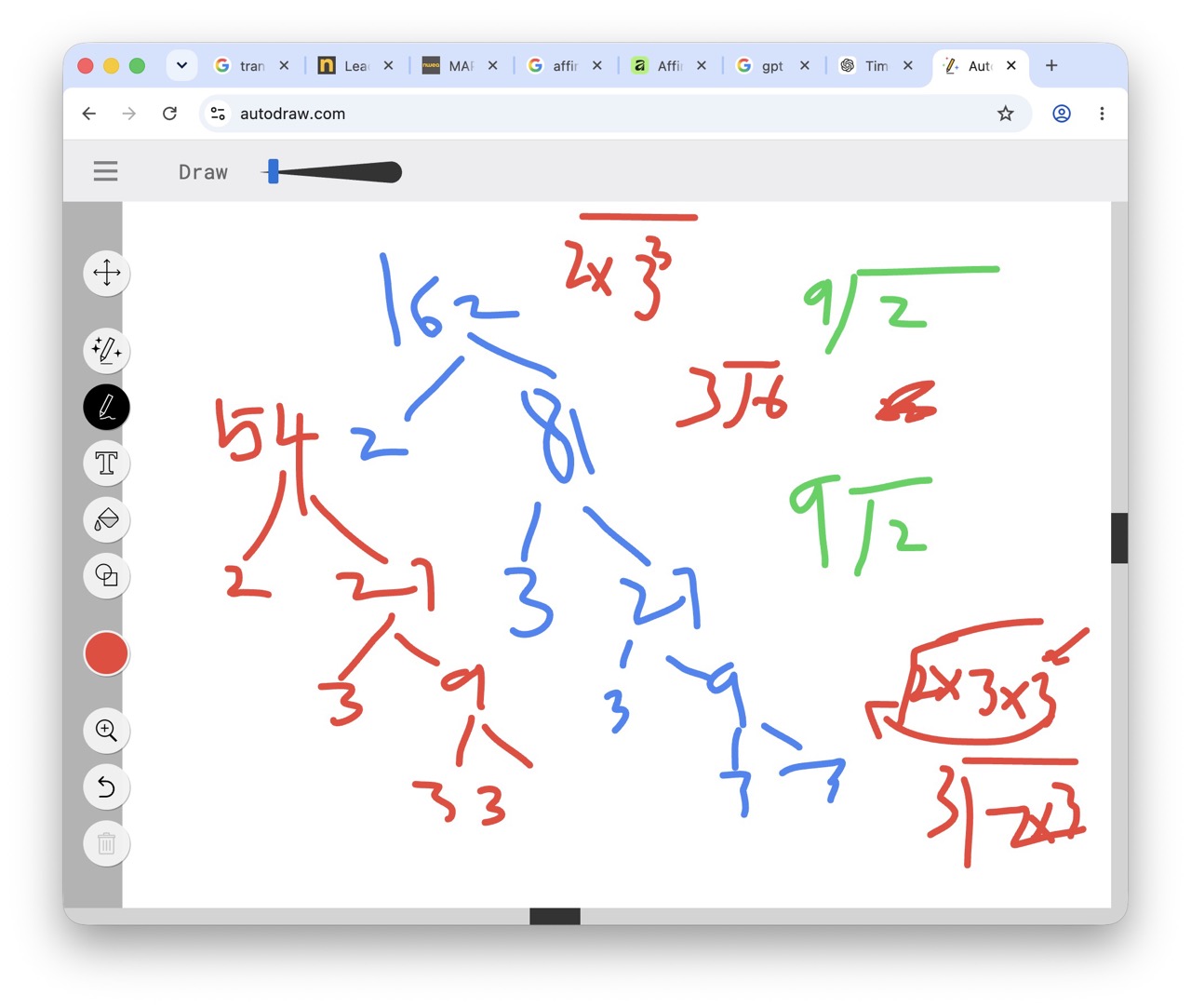
And when Cloud reached 15/√3, Donald simply said:
“If it is 15/√3, you were right.”
😂
Learning
A class can begin with a misunderstanding about whether the class is happening at all.
A student can arrive late, bring a problem from memory, struggle with SOH CAH TOA, make a mistake on a school quiz, discover a better way to simplify an answer—and then verify his own result twice.
The interesting part isn't that Cloud learned a trig formula.
It is that he became curious about whether his own answer was true.
That curiosity is much more valuable than getting one quiz question right.
Theme
Don't just teach students how to get an answer. Give them ways to challenge the answer.
What Is Possible?
A formula can become a tool for exploration rather than a procedure to memorize.
How Does It Happen?
Give the student a problem worth solving—and a second mathematical idea that can challenge the first answer.
Why Does It Matter?
Because eventually the student stops asking, “Is this what the teacher expects?” and starts asking, “Can I prove to myself that this is right?”
And yes, the final line almost has to be:
Reality edited the exhibit for us.