
Living Museum of Learning
Hide the Icosahedron
Situation
Yesterday, the word icosahedron had to wait.
Today, we went one step further.
I let Leo make a copy of his project 3DWorld and rename it polyhedron.
We had a rule:
Hide "icosa-"
Hide "20".
No icosahedron.
No 20 faces.
We were going to discover something without knowing where it was going.
Turning Point
"Let's hide the 12 vertices."
Leo made them disappear in seconds.
Then:
"We want to put a dot in the center of one triangle."
He started spinning the object, looking at the three or four triangles he had rendered. The rest was still mostly a frame or scaffold.
"We can hide triangles except one. What about this one?"
Now there was somewhere specific to look.
I asked:
"Where is the center of that triangle?"
Leo thought for a moment.
"The center of the height."
Cute.
Almost right.
Time for the whiteboard.
We opened AutoDraw.
I let Leo make a tiny circle first, just to establish a point.
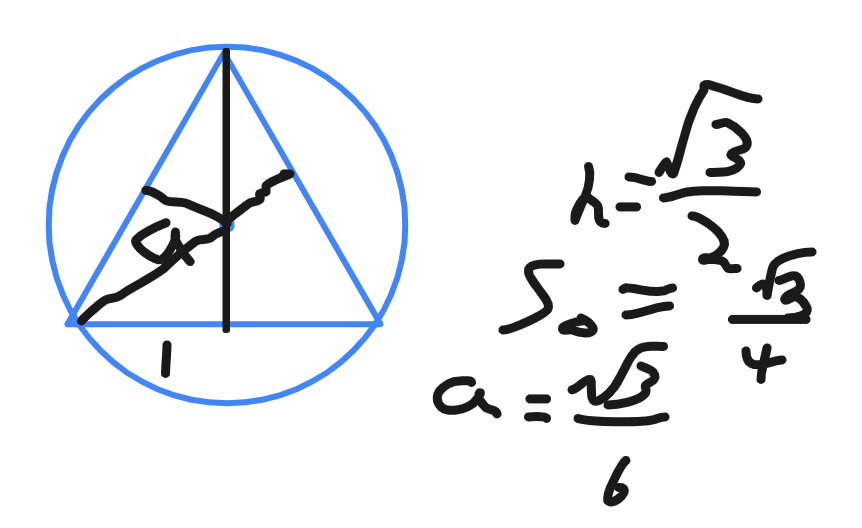
Then he used the triangle tool to draw an equilateral triangle inside the large circle.
And suddenly his answer became visible.
The center of the triangle was not at the middle of its height.
"Not in the middle, right?"
He could see it.
No explanation was necessary.
Then:
"Now calculate it."
Leo talked very little.
But he understood.
Emergence
I told him:
"You can use letters on your diagram if you like. Capitalized for vertices and lowercase for sides."
Leo put an a on one side.
Since he already understood ratios so well, I suggested:
"We can use 1 instead of a to keep it simple, right?"
He agreed—but then put a on the one-third section of the height.
I liked that immediately.
He was choosing his own notation.
Then I noticed an S.
"What's it?"
Leo didn't answer.
Instead, he added a little triangle as a subscript.
S△
"Oh! Area."
I was excited.
"Wow, that's a cool idea."
He had invented his own notation for the area of the triangle.
He calculated:
S△ = √3 / 4
and then:
a = √3 / 6
The little triangle had become a mathematical laboratory.
The Next Wall
After I learned that Leo wanted to use the height of the triangle, I said:
"Let's put two dots at both ends of the height."
He did it quickly.
Now he had the ratio √3/6.
And then he paused.
I could sense the difficulty.
The next problem wasn't really about the triangle anymore.
It was about what exactly "one-third of the way between two points" means.
So we left 3D.
Time for Desmos.
2D this time.
"Put two arbitrary points on the plane."
No problem.
"Now the middle point between them."
No problem.
"Now the 1/3 point."
Oops.
He hadn't learned how to do that yet.
Timed out.
Perfect.
That became homework.
Learning
The interesting thing about this lesson was not that Leo found the center of a triangle.
He didn't finish.
Instead, we found the exact place where his understanding stopped.
And that is useful.
He already knew:
how to work with ratios,
how to locate a midpoint,
how to calculate the area of an equilateral triangle,
how to create his own notation,
and how to work with a 3D structure.
But he didn't yet have a way to construct the 1/3 point between two arbitrary points.
So we stopped there.
No rescue.
No formula.
Just two small doors left open.
Homework
hw1: Render all the triangles/faces of the project 3D World and count the number of faces.
hw2: Find the 1/3 point in the Desmos example.
One homework finishes the outside.
The other finishes the inside.
And perhaps, next time, they will meet.
Theme
Hide the answer and let the geometry reveal it.
We hid icosa-.
We hid 20.
We hid most of the triangles.
Then we hid everything except one height.
Eventually, there was nowhere left to hide.
Except the mathematics.
What Is Possible?
A complicated 3D object can become one triangle, one height, and one tiny ratio.
How Does It Happen?
Hide things. Isolate one idea. Draw it. Question it. Calculate it. Stop when the next question becomes real.
Why Does It Matter?
Because sometimes the best lesson ends exactly where the student gets stuck.
That's where the next lesson is waiting.