
Living Museum of Learning
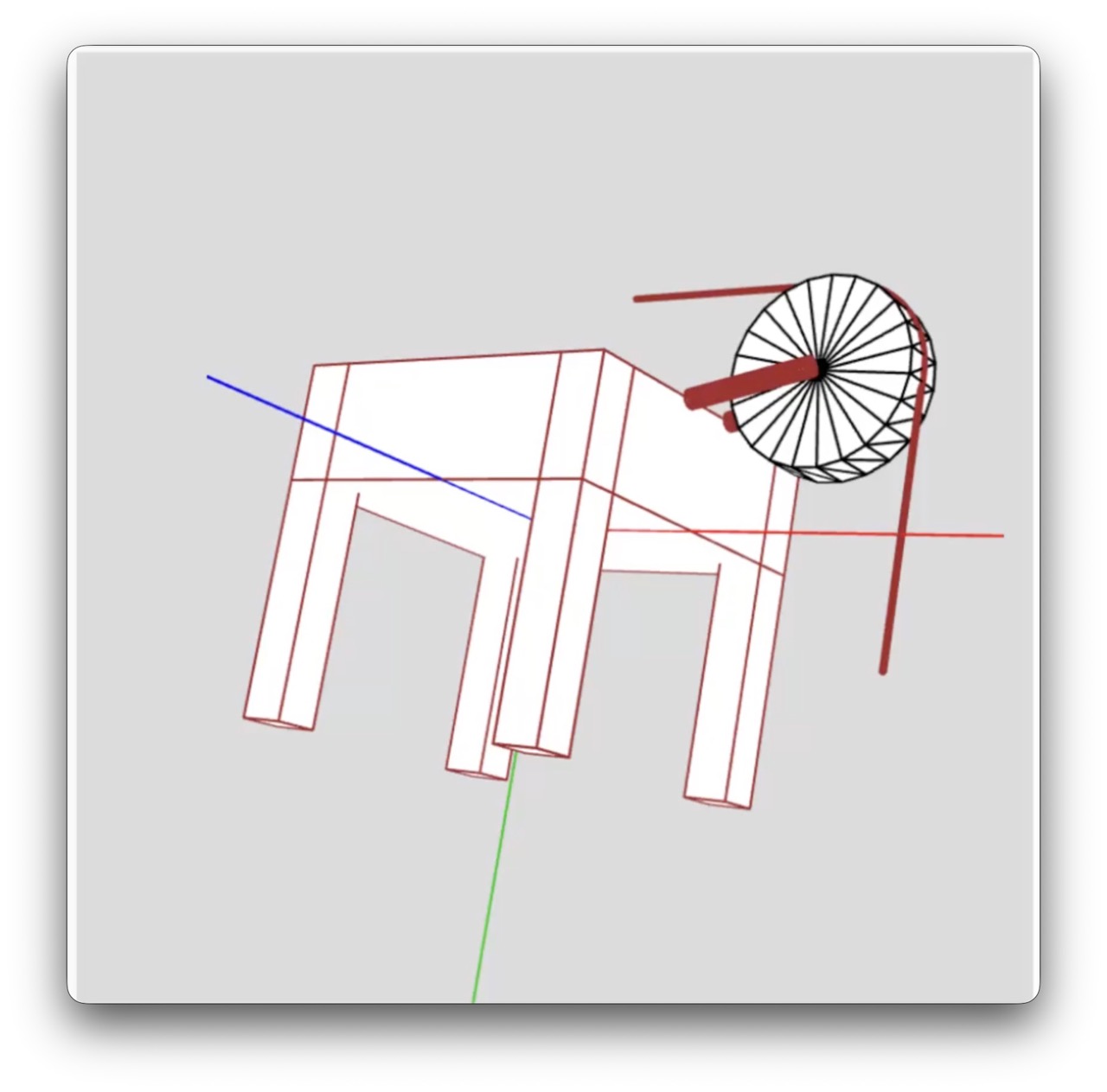
The Rope Is Done! — Enning's 3D Pulley
Situation
Nearly three months ago, I didn't even know Enning's name. I quietly asked her dad:
“Can I also give Tianjing's sister some help?”
The description I heard wasn't particularly encouraging: a careless drama queen, supposedly not good at math and logic.
Over the past two months, Enning has been changing that impression — not by arguing with anyone, but by learning, building, and showing what she can do.
One of her projects is a 3D pulley, created with p5.js and WEBGL.
Modeling the pulley wheel was one thing. Making the rope look right in 3D was much harder.
Enning initially wanted to use a cylinder for the horizontal segment at the top. We discussed how that might make connecting it to the quarter-circle rope around the pulley more difficult, since we had already drawn the curved segment using line().
The challenge wasn't simply to draw three pieces of rope. They had to work together geometrically: a straight segment at the top, a quarter-circle following the wheel, and another straight segment hanging down on the right.
Emergence
Today, the hardest part of the 3D pulley — the rope — is done!
You can see her work in our Living Gallery:
Explore the 3D pulley rope — Living Gallery LG-0058
And there is another development worth celebrating.
On Khan Academy, Enning has become fluent enough at complex-number multiplication to calculate mentally in groups instead of writing every intermediate step. When she moved on to complex-number division, she completed a round without a single mistake. As the denominator cancelled, she looked at the result and said:
“真棒!”
Wonderful!
Learning
The most interesting part of Enning's progress isn't any single correct answer or finished piece of code.
It's how quickly she can change her approach when she understands a better way to work.
In mathematics, she is learning to combine familiar operations mentally. In programming, she is learning to think about how geometric components fit together before choosing how to draw them.
These are different projects, but they share something important: understanding the structure of a problem.
Perhaps the girl who was supposedly not good at mathematics and logic simply hadn't yet been given enough opportunities to show what she could do.
Theme
Don't confuse a student's current performance with the limits of her potential.
Give her a real problem, the tools to explore it, and room to grow. Then watch what emerges.
The rope is done. The pulley is becoming real. And Enning is still learning.
There is more to build!