
Living Museum of Learning
The Rainbow Door
Situation
For a long time, the Living Museum homepage greeted visitors with numbers: their visitor ordinal, the total number of visitors, and sometimes a little “Welcome back.”
It was useful data. But Donald began wondering whether a homepage should do something more human.
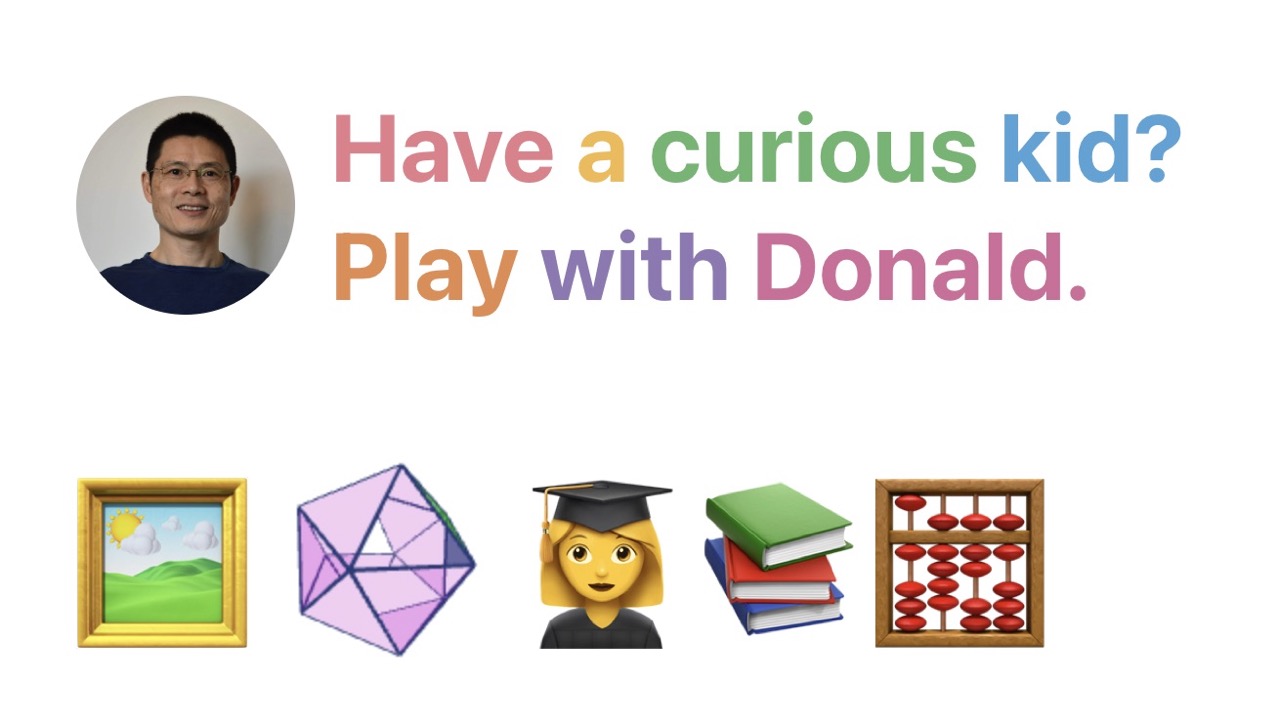
The museum already had five little doors: Gallery, Living Gallery, Learners, Library, and Mathematicians. What if, instead of another number, the space between the museum header and those doors could invite a parent to begin a conversation?
The requirement sounded simple:
Make it easy for a parent to say, “I have a curious kid.”
And then we started playing.
Turning Point
The first idea was a portrait of Donald beside an email invitation.
Then CSS reminded us that nothing involving an <img> tag is ever quite as simple as it looks. The museum's global image rules—max-width, height, margins, display behavior—fought with the little portrait.
For a moment, this tiny homepage change became rocket science. 😂
Instead of fighting the entire stylesheet, we changed tactics: Donald's portrait became a span with his photograph as a background image. Suddenly the portrait behaved.
Then came the next problem.
Should there be an email icon?
Should the words say “Can my kid do this?”
No. Too much like a contact form.
“Let's talk.”
No. Too commercial.
“Let Donald know.”
Much better.
Then someone said:
“Play with Donald.”
And the whole thing changed.
Emergence
We eventually arrived at a tiny new door:
Have a curious kid?
Play with Donald.
The portrait stayed.
The email icon disappeared—because once the invitation became playful, the envelope was redundant. It made the thing look like a contact widget instead of another door into the museum.
The two lines became larger.
The gap between Donald and the words was cut in half.
And then we decided to stop behaving like adults.
Why not rainbow-color every word?
Not one color for the whole sentence. Not a tasteful accent. Seven words, seven colors:
Have a curious kid?
Play with Donald.
The first colors were too strong. Red was shouting. Some colors repeated. We adjusted them. Coral, golden yellow, green, blue, orange, purple, pink.
Suddenly the little invitation looked less like a button and more like a toy.
And the toy had one more trick.
Clicking it opens an email to Donald with everything already prepared:
Subject: A curious kid
Hi, Donald,
I found the Living Museum and have a curious kid!
A parent can literally open the email and press Send without typing a single character.
No registration.
No form.
No questionnaire.
No requirement to explain the child's age, grade, interests, coding experience, mathematical background, or anything else.
Just one tiny door.
Learning
We started by trying to replace a number with a contact mechanism.
We ended up discovering that the real problem was not contact at all.
It was invitation.
A museum can say:
“Here is my visitor count.”
It can say:
“Contact me.”
Or it can simply say:
Have a curious kid?
Play with Donald.
The last one doesn't explain what will happen.
That's part of its charm.
Maybe they will play with math. Maybe coding. Maybe chess. Maybe something nobody planned.
We don't need to decide that on the homepage.
We made the door easy to open.
Now we get to do the most interesting part of the experiment:
put the toy in the world and see whether anyone plays with it. 😂
Theme
Playful Invitations
What Is Possible
A homepage contact point can become a playful sixth door—not a form, not a sales pitch, but an invitation to begin something.
How Does It Happen
Notice a small friction, try an idea, hit some ridiculous CSS rocket science, change direction, iterate on the words, colors, spacing, and interaction—and ship it before the idea gets overthought.
Why Does It Matter
Because learning often begins before anyone knows exactly what they are going to learn. Sometimes all that is needed is a curious child, a playful invitation, and a door that is extraordinarily easy to open.