Living Museum of Learning

The Curator's Day
September 12, 2026 began before sunrise.
At 5:16 a.m., I asked Tianjing and Enning whether they wanted to start class.
Five minutes later, Enning sent me a message:
“Teacher, you've worked so hard, wouldn't you like to take a day off? My sister and I don't mind at all 🫤”
I thanked her for the warm words and asked, “Who starts first? 45 minutes each.” 😁
She volunteered to go first.
I didn't tell the sisters that I had something else planned for later that day.
After teaching, I went to the 高校杯 badminton tournament with my Tsinghua alumni team.
We hadn't made it out of the group stage for several years.
Then came a remarkably dramatic day.
Tsinghua defeated our longtime rival, Xiamen University, 3–2 and advanced to the Round of 16.
The decisive point was won by Donald and Jade—me, playing one of the most important matches of the day.
Jerry, our team captain, later wrote in the 160-member group:
“最后Donald 和Jade 赢下关键一分,而且是完胜👍👍”
The team went out for dinner to celebrate.
I didn't go.
When Cloud's mother asked whether I could teach Cloud the next morning, I said:
“可以啊。高校杯打完了。他们去聚餐,我回家和cloud聚会。[Grin]”
She asked whether I had been playing a match and whether it was too tiring.
I told her the story of the 3–2 victory.
Then I explained why I had skipped the celebration:
“我不喜欢凑热闹。喜欢玩数学,在运动之后。😂”
The next morning, I did not actually need to wait for the next day.
Cloud's one-hour class became another victory.
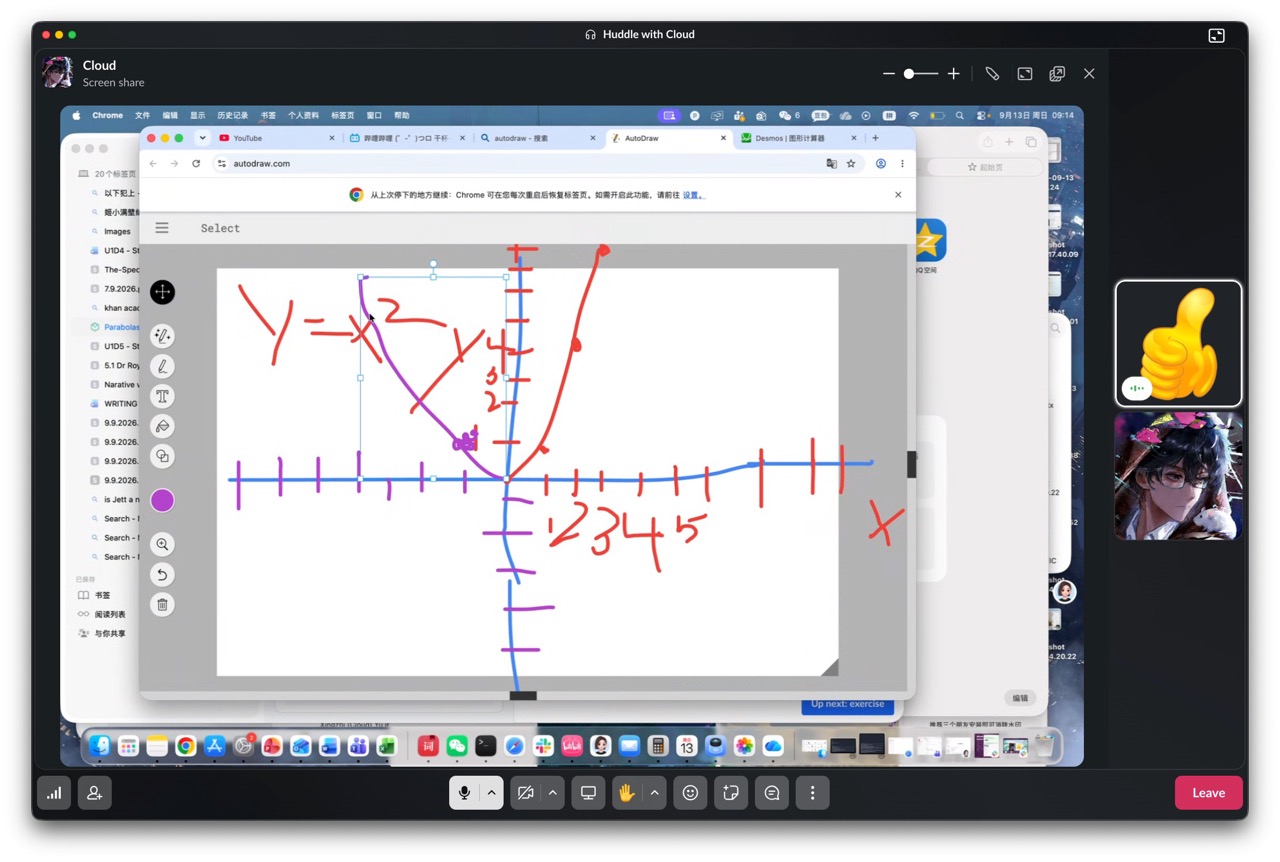
We explored parabolas.
He learned what a parabola is, found its vertex, and understood its axis of symmetry.
Then we started transforming the basic curve y = x^2.
He learned how to move it up and down.
Then he asked the question almost everyone asks the first time:
Why does (x - 2) move the curve to the right?
Instead of simply memorizing “minus means right,” we explored what is happening inside the function.
He then learned how to make the parabola wider or narrower, and how to flip its opening.
In one hour, Cloud went from asking what a parabola was to understanding the main ways we can transform one.
The curator had two victories in two different arenas.
A day can contain very different kinds of learning.
On the badminton court, I experienced something I had not experienced with the Tsinghua team for years: making it out of the group stage.
In the classroom, Cloud discovered that an equation is not just something to calculate with. It can describe an object that we can move, stretch, squeeze, and flip.
And perhaps the most important part was the question about (x - 2).
A learner who asks “Why?” at exactly the point where a memorized rule stops making sense is already doing mathematics.
A good day does not have to be planned as a lesson.
Sometimes it is a badminton match.
Sometimes it is a parabola.
Sometimes it is a teenager telling her teacher to take a day off.
And sometimes the best celebration after a hard-fought victory is simply going home and playing mathematics with a student.
A teacher can spend the same day teaching, competing, learning, and celebrating—with no need to separate these activities into different lives.
By showing up. On the court, in the classroom, and wherever a curious question appears.
Because learning is not something that happens only during “lesson time.” A life full of curiosity can make the whole day part of the museum.