Living Museum of Learning
Finally
Four weeks ago, Tianjing’s father asked Donald to help bring her self-confidence back.
At that time, Tianjing struggled to read even Grade 2 math problems in English. During the previous twelve months, she had spent only about two months in school.
Now, the first anniversary of her arrival in England was approaching—and so was the beginning of Grade 9.
Instead of spending months trying to repair every missing piece one by one, Donald and Tianjing began with a wide scan.
Over four weeks, she worked through Khan Academy mathematics from Grade 2 toward Grade 8. When English became the obstacle, she used a digital dictionary and kept going.
At the same time, mathematics became connected with programming.
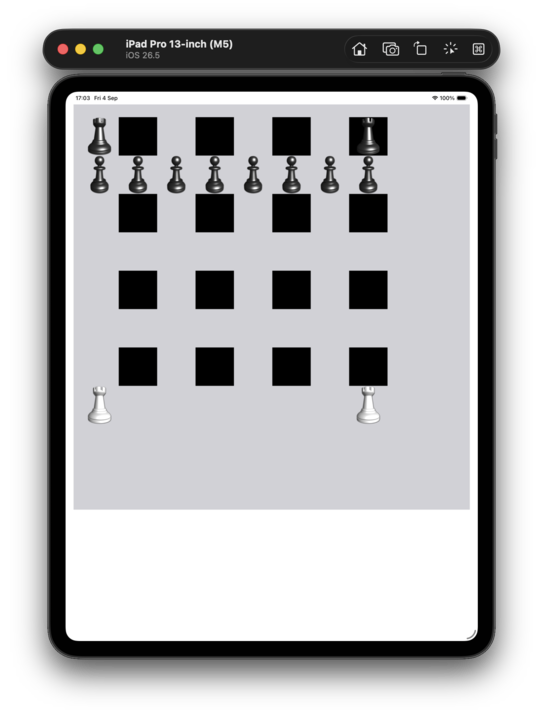
She learned Python and p5.js, then began building iOS projects with Swift. She learned loops, arrays, coordinates, and patterns. She could find the maximum in an array of random numbers—and even the second largest. She began replacing repeated instructions with nested for loops while building a chessboard.
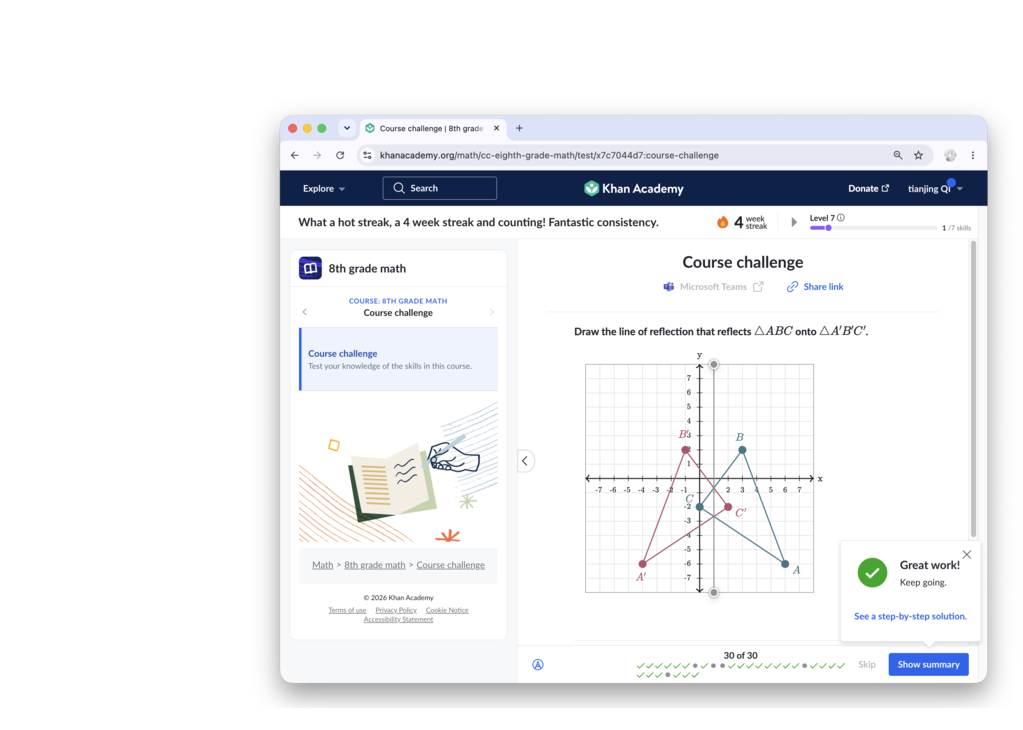
On Friday, September 4, Tianjing finally completed her Grade 8 Khan course challenge:
25/30.
For Tianjing, “finally” meant:
“Finally, I finished Grade 8.”
For Donald, it meant something much bigger:
“Finally, when Grade 9 begins on Monday, you won't have an obvious hole in your math foundation.”
In just four weeks, Tianjing had scanned and covered mathematics from Grade 2 through Grade 8, encountering powers, square roots, the Pythagorean theorem, and much more.
She still could not reliably type a simple complete English sentence correctly.
But something important had changed.
Her mathematical and computational thinking had begun to move ahead of her English.
She could understand much of Grades 5–8 mathematics with a digital dictionary. She could touch type. She could write programs. She could recognize patterns. She could build things.
And, perhaps most importantly, she had accumulated evidence that she could learn.
Confidence is not always something we give a child by saying, “You can do it.”
Sometimes we rebuild it by creating enough opportunities for the child to discover:
I can do this.
I can figure this out.
I can make something work.
I can learn something that looked impossible before.
The 25/30 was the visible result.
The much larger by-product was a learner who had begun to see herself differently.
Four weeks earlier, Grade 2 math was difficult to read.
Four weeks later, Grade 8 math was something she could enter, explore, and solve.
And on Monday, Grade 9 would begin.
Not because every gap in her education had magically disappeared, but because she had reached the next grade with something far more important:
the confidence to keep learning.
A remarkable amount of learning can emerge in four weeks when a learner is given the right combination of challenge, support, continuity, and room to explore.
Repair the foundation while simultaneously giving the learner real things to build, solve, program, and discover.
The goal is not simply to catch up. It is to help a learner cross the next threshold believing, from her own experience, that she belongs there.