
Living Museum of Learning
Debugging the Mathematician Wing
We were turning the manually built Mathematicians wing into something MuseCoreStudio could actually manage.
First came the ability to load the 22 mathematicians from JSON, edit their names, birth years, death years, taglines, and save the changes. Then we built the ability to create a new mathematician.
But a mathematician needs more than words and numbers. Each one has a portrait.
So we built portrait selection, preview, copying, and replacement—one tiny step at a time.
Then, while testing the new creation workflow, we needed a harmless image.
Naturally, I chose rhea_on_train.jpg. 😂
The selected image became the portrait of a temporary future mathematician.
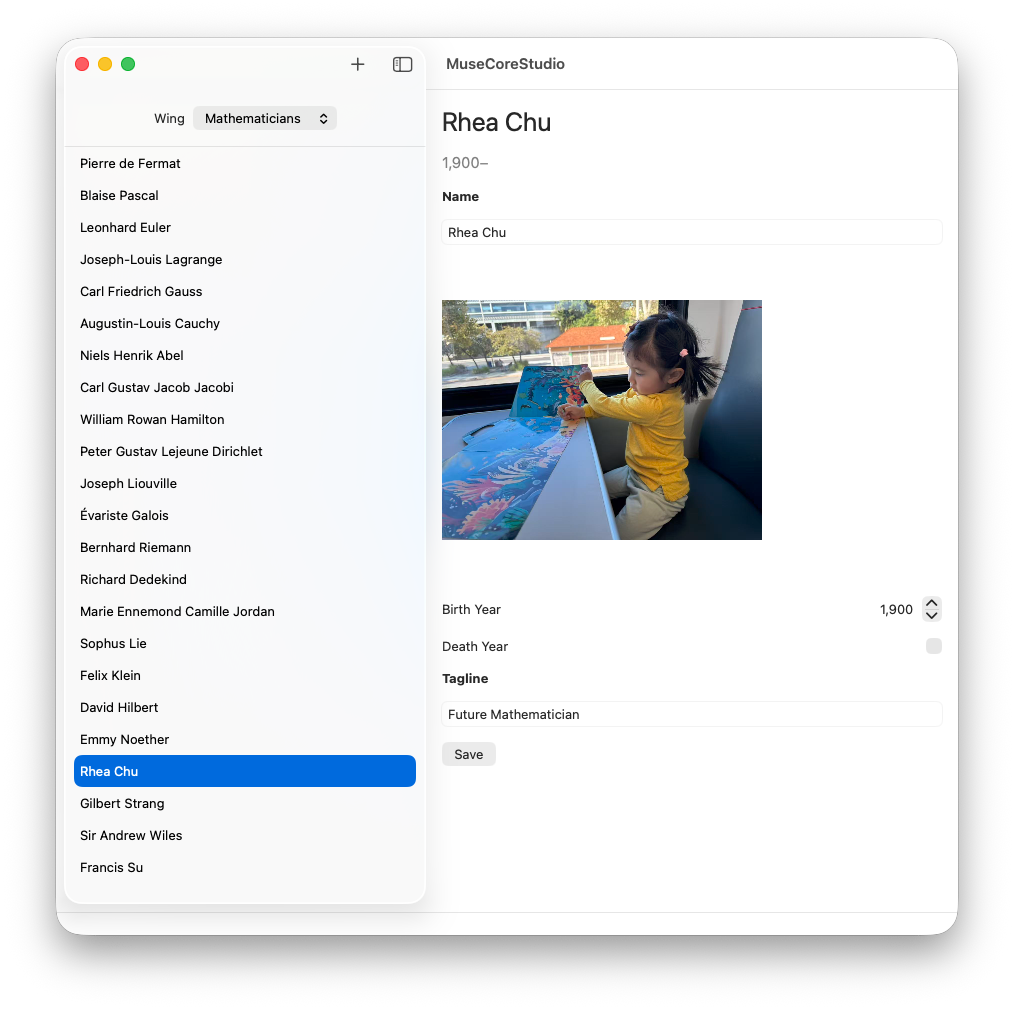
The creation form still had its default birth year of 1900, so the screen suddenly showed a wonderfully absurd combination:
Future Mathematician Rhea — born 1900 — portrait: Rhea on a train.
Then we took a screenshot.
And that screenshot became rhea_future_mathematician.png.
But the story didn't stop there.
We used that very screenshot to test Change Portrait… on an existing mathematician.
The image of a future mathematician, created while debugging the Mathematicians wing, had now become an image inside the Mathematicians wing.
Finally, we changed the portrait back to rhea_on_train.jpg.
Something unexpected had emerged from a sequence of tiny engineering steps:
The museum was beginning to contain evidence of its own construction.
MuseCoreStudio was being built to manage the museum.
While testing MuseCoreStudio, we created a future mathematician.
The screenshot of creating that mathematician became her portrait.
That portrait was then used to test the museum's portrait-replacement mechanism.
The tool was building the museum, while the museum was beginning to remember the process of being built.
A small debugging experiment had become a piece of the museum's own history.
Good software architecture does not have to be designed completely in advance.
We built one small capability, verified it, and then built the next:
model → save → edit → create → choose → preview → copy → replace
Each successful step revealed what the next step should be.
The most interesting results were not always planned. Sometimes they appeared because we were willing to experiment, laugh at the unexpected, and keep the artifact instead of throwing it away.
And perhaps that is also how a living museum should be built.