
Living Museum of Learning
The Door Is Open — Ivy Chooses Where to Go
When the 14-day experiment began, the question was fairly simple:
What happens if Ivy gets a much more continuous learning experience than the 2 hours/week we had been doing?
Nine days later, the experiment ended—not because we ran out of things to learn, but because Ivy had discovered something she wanted to pursue on her own.
And the last class turned out to contain three very different kinds of learning.
Turning Point 1 — One Line, Many Forms
During a Khan problem, Ivy encountered a linear equation.
Slope and y-intercept were already familiar territory. Give her two points, and she immediately turned them into:
y = kx + b
So we opened Desmos and started playing.
Then I gave her an x-intercept and a y-intercept.
She reached for the same tool.
Instead of giving her another formula, I nudged her to keep changing the form of the equation.
Again.
And again.
Eventually she saw the pattern.
Then she used that pattern to write a new line.
We put it into Desmos.
It worked.
The interesting thing wasn't that Ivy learned another way to write a line.
It was that she experienced something more important:
The representation can change while the mathematical object stays the same.
She had started with a familiar tool. We changed the representation until the structure became visible. Then she used the structure herself.
Turning Point 2 — “We Are Lucky.”
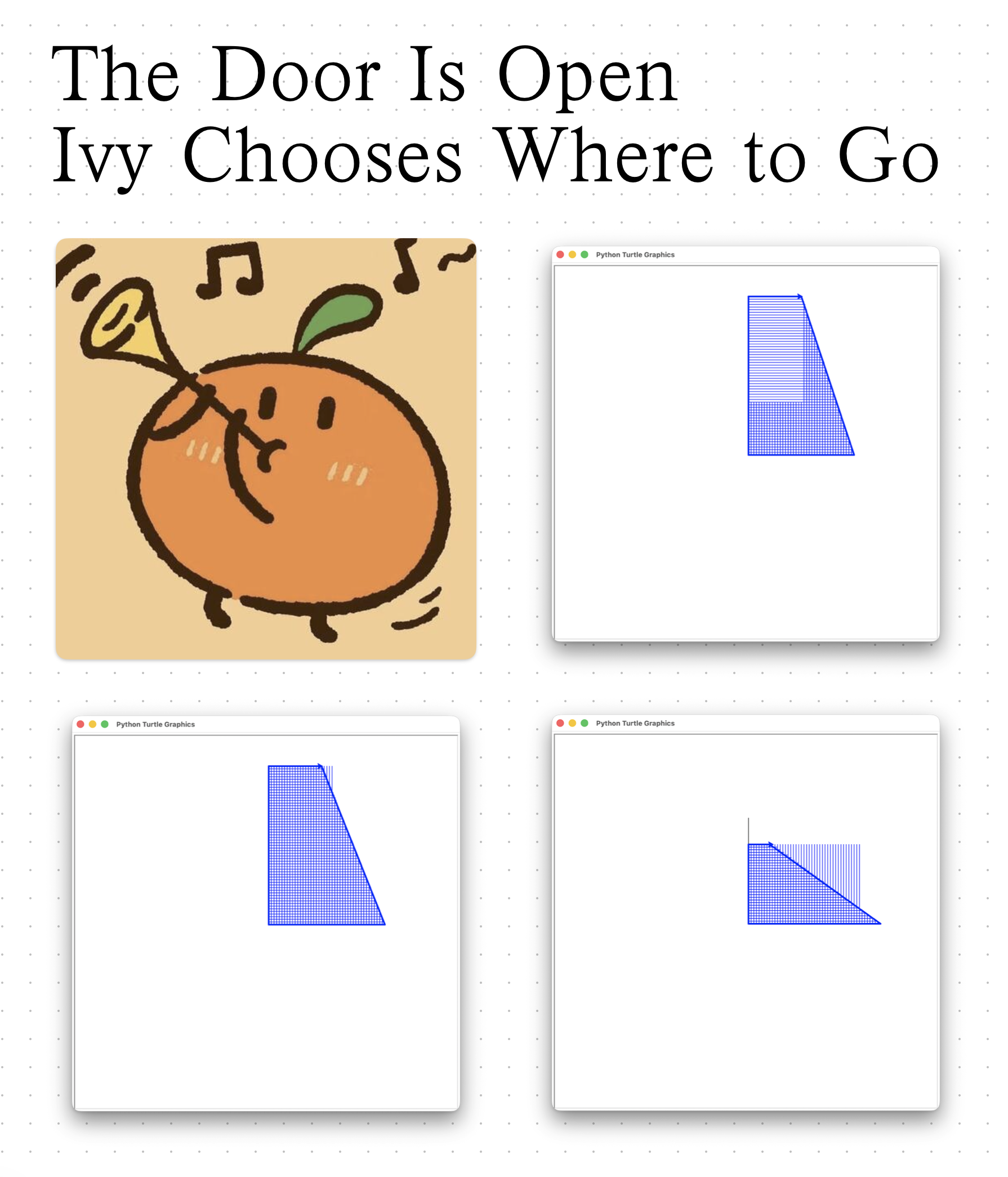
The same class also gave us two bugs.
Ivy had changed her Python Turtle program from using three hardcoded dimensions to asking the user for:
top, bottom, and height.
That seemingly small change turned a drawing into a real test of whether her algorithm was actually general.
The first version exposed one problem.
We made another version.
The first two tests of Version 2 were particularly interesting: the output looked suspicious, but neither of us could immediately tell whether we had found a genuine bug or merely an edge case caused by approximation.
So I said:
“Let's change the shape more.”
💥
The bug revealed itself.
We laughed.
“We are lucky.”
And Ivy took two screenshots, one for each bug.
That was not just debugging.
She had experienced the difference between:
“My code worked once.”
and
“My algorithm works for the whole class of inputs.”
And when the evidence was ambiguous, we didn't guess.
We changed the experiment.
By the ninth day, Ivy had accumulated something much more valuable than a collection of completed exercises.
She had seen herself:
score 29/30 on the Grade 8 Khan Academy Course Challenge;
get stuck on a simple ratio and then discover the pattern;
learn to look at mathematical representations differently;
turn geometry into coordinates and reusable code;
find bugs by deliberately changing the input;
and preserve the bugs as evidence rather than hiding them.
But then something unexpected happened.
The student made a choice.
The Choice
Ivy joined a one-week summer camp at the University of Toronto.
And there, she felt that she had finally found something she had been looking for for years:
3D modeling.
Not necessarily the mathematical/code-based 3D modeling we had been doing.
For now, she prefers manual 3D modeling, using tools such as Onshape.
And instead of continuing the remaining five days of the experiment, she decided that she wanted to spend the coming months exploring this interest.
I let her go.
Of course I have my own thoughts about how far that interest will take her. 😂
But that's not the point.
She found something she wants to explore.
She knows that coding will matter in engineering.
She knows I am available if she needs coding or something else.
And she even thanked me for opening the real 3D door through our coding projects.
So the door did its job.
It opened.
She doesn't have to walk through it in the direction I expected.
Perhaps the most important outcome of the experiment was not a score.
It was not even the 29/30.
It was seeing that Ivy can learn quickly when the learning environment becomes continuous—and seeing more clearly what she needs to develop: mathematical fluency, flexible representations, pattern recognition, abstraction, and the habit of testing assumptions.
But there was one more discovery.
Interest cannot be assigned.
A teacher can open doors.
A teacher can show what is behind them.
A teacher can build foundations.
But eventually, the student has to choose which door she wants to walk through.
For now, Ivy has chosen 3D modeling.
So I'll let her explore.
And if the interest fades as quickly as some interests do... 😂
I'll still be here.
Because now she knows where the coding door is.
Three Doors
🧮 The Mathematics Door
Can Ivy learn to move beyond familiar formulas and see the same structure in different representations?
🐛 The Engineering Door
Can she turn a working example into a genuinely general program—and learn to welcome the bugs that reveal hidden assumptions?
🚪 The Choice Door
What happens when a student finally finds something she genuinely wants to explore, and the teacher doesn't try to pull her back?