Living Museum of Learning
The First Door After Another
After a full year of knowing Ivy and watching her learning pace, Donald had become increasingly convinced that she had been moving too slowly. Ivy is a Grade 10 student who hopes to pursue engineering and dreams of attending an Ivy League university. She is capable and curious, but her mathematical foundation—especially algebraic manipulation—was not as strong as her overall ability suggested.
After a long discussion about the value of programming for a future engineer, Ivy agreed to try a 14-day experiment: one hour every day.
Before the first class, after her parents had prepaid, Donald sent her a BrainyQuote:
“The delight of self-discovery are always available.”
— Gail Sheehy
He followed it with a 24 puzzle:
2, 7, 7, 10
Then, at exactly 8:00 PM Toronto time on August 24, 2026, Class 1/14 began.
Ivy's familiar voice appeared from the other end.
“Do you know golden ratio?” Donald asked.
“Yes.”
“Good. Let's go to our whiteboard, autodraw.com, to talk about it.”
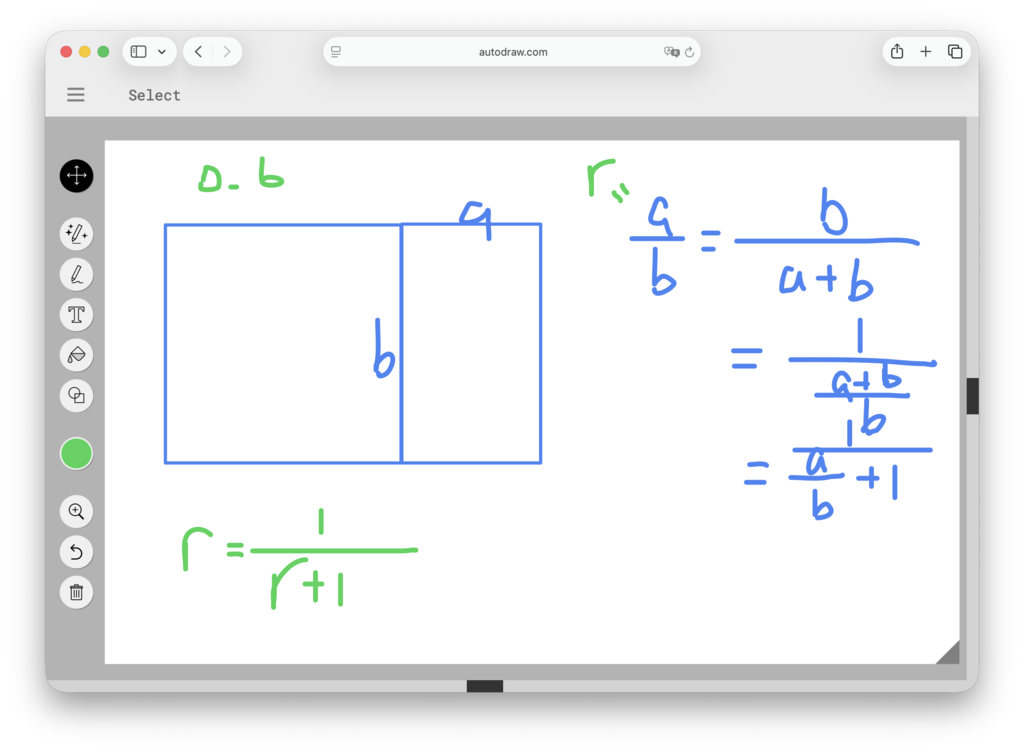
Ivy immediately drew a rectangle and a spiral inside it. 😂
Donald simplified the starting point: draw a square, then a rectangle, and look at the ratio of one side to the other.
She understood the geometric idea quickly.
But when Donald asked her to calculate the ratio, she introduced a and b, wrote an equation, and got stuck.
That was the first important discovery of the evening: Ivy's visual and geometric intuition was ahead of her algebraic fluency.
Donald guided her without simply giving her the answer.
He pointed out that a horizontal fraction bar would be more convenient than the slash /.
Then he asked:
“Could you do something on the right hand side to get closer to what we need?”
She still couldn't move forward.
Even when the equation had become:
a/b = 1 / ((a+b)/b)
Donald had to say:
“Keep going.”
Then he asked:
“Is it easier to give a/b a name?”
Ivy introduced a variable r.
Donald then used one of his favorite teaching moves:
“Guess the value. Because after a few minutes we'll have the true one.”
Ivy estimated:
3:5
“Good. Put 0.6 down.”
She then carefully worked through the algebra:
r(r + 1) = 1
r^2 + r - 1 = 0
r1 = (-1 + sqrt(1 - 4*1*(-1)))/2
= (-1 + sqrt(5))/2
= 0.618
Donald immediately pointed out:
“Wow, your estimation is so close, just by examining the geometry.”
Her geometric intuition had predicted the answer before the algebra confirmed it.
She also found the other root:
r2 = (-1 - sqrt(5))/2 = -1.618
and then:
1/r1 = 2/(sqrt(5) - 1)
= (sqrt(5) + 1)/2
= 1.618
The golden ratio was no longer merely a beautiful picture she recognized. It had become an algebraic object she could manipulate.
Then Donald opened the next door.
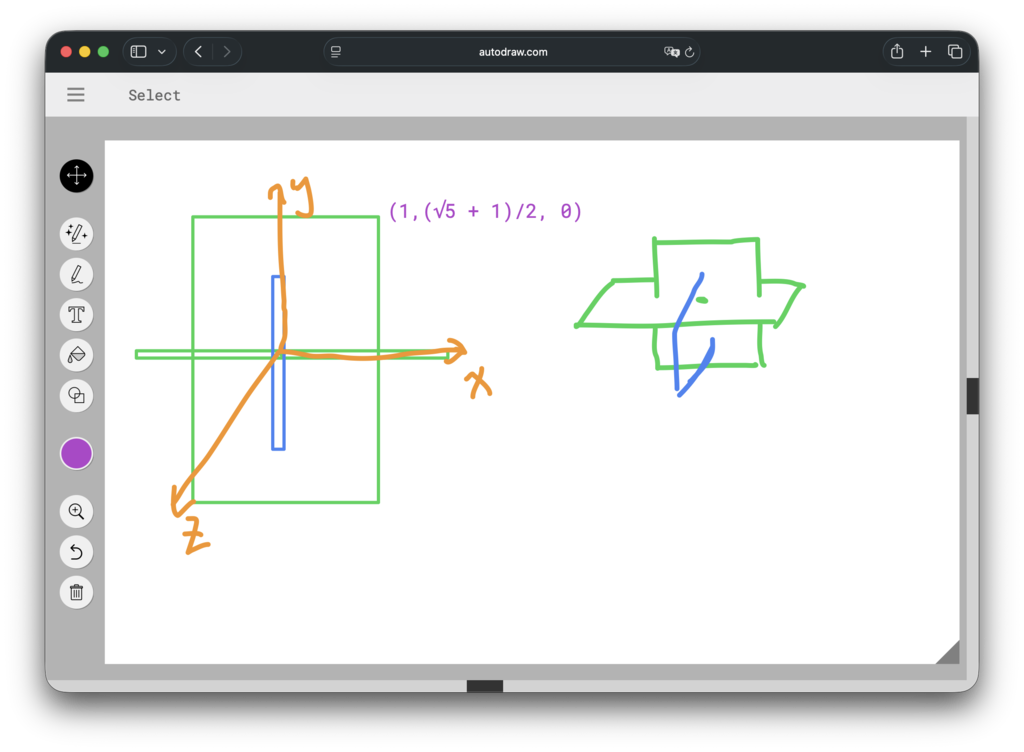
He asked Ivy to place two golden rectangles perpendicular to each other and centered at the same point.
Her first attempt worked perfectly.
No adjustment was necessary.
Donald became excited:
“Now add the 3rd piece, in the same way.”
Ivy thought for several minutes.
She found a way to insert the third rectangle without breaking the rules. But she noticed that the relationship between the third and second rectangles was different from the relationship between the first pair.
She didn't ignore the discrepancy.
She tried again.
Then suddenly:
“Oh, I got it.”
She found the correct slot for the third rectangle.
At this point, Ivy still had no idea what Donald was leading her toward.
She had just helped construct the framework of an icosahedron.
The geometry now opened another door: 3D visualization.
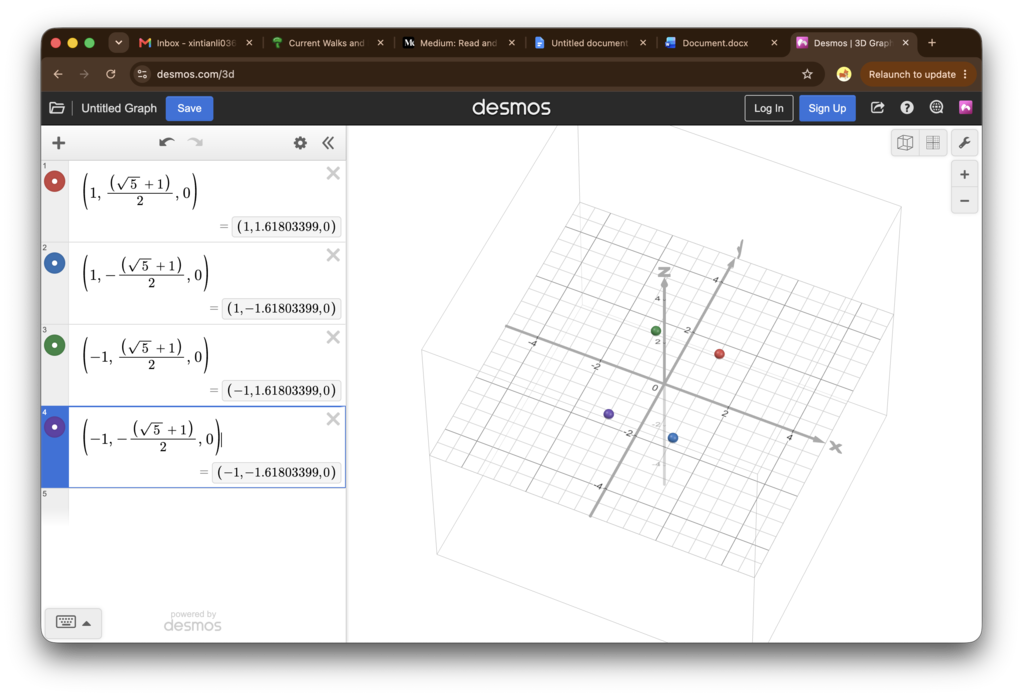
Ivy already knew Desmos, but she had never used its 3D environment.
Donald asked her to put four points into Desmos.
Then he gently said:
“You can turn the coordinate system on the right.”
Ivy rotated the coordinate system and examined her points from different angles.
“Wow, so cool.”
She could now see her mathematical construction as an object in three-dimensional space.
Donald deliberately did not spend too much time there.
There were still 15 minutes left.
So he opened yet another door:
p5.js 3D.
For the first time, Ivy encountered WEBGL.
In roughly fifteen minutes, she was already experimenting with:
createCanvas(500, 500, WEBGL)
orbitControl()
3D coordinate axes
translate()
sphere()
and coordinates involving the golden ratio itself.
Her program included:
function setup() {
createCanvas(500, 500, WEBGL);
}
function draw() {
background(220);
orbitControl();
line(0, 0, 0, 200, 0, 0)
line(0, 0, 0, 0, 200, 0)
line(0, 0, 0, 0, 0, 200)
push();
translate(100, (sqrt(5)+1)/2 * 100, 0);
sphere(5);
pop();
push();
translate(-100, (sqrt(5)+1)/2 * 100, 0);
sphere(5);
pop();
push();
translate(100, -(sqrt(5)+1)/2 * 100, 0);
sphere(5);
pop();
push();
translate(-100, -(sqrt(5)+1)/2 * 100, 0);
sphere(5);
pop();
}
Fifteen minutes earlier, she had never touched p5.js 3D.
Now she had begun building a 3D mathematical world of her own.
After class, Ivy made a video demonstrating her p5.js work and shared it in both Slack and her family WeChat group.
The first class had not followed a predetermined list of programming topics.
Instead, one door had opened after another:
golden ratio → algebra → geometric estimation → three-dimensional construction → icosahedron → Desmos 3D → p5.js 3D.
The first lesson revealed both strengths and gaps.
Ivy was not yet mathematically fluent enough to manipulate the algebra effortlessly. Donald had to nudge her several times. The difficulty with transforming
a/b = 1 / ((a+b)/b)
into the desired relationship showed that she had spent too much of the previous year without sufficiently intensive mathematical development.
But something equally important emerged.
She could see structure.
She could estimate the golden-ratio relationship from geometry before calculating it exactly.
When the third golden rectangle did not initially fit the same way as the first two, she noticed the inconsistency and kept investigating until she found the correct placement.
When she entered her first points into Desmos 3D, she immediately wanted to rotate the coordinate system and inspect the object.
And when p5.js 3D appeared, she did not need a long lecture before beginning to experiment.
This is exactly the kind of learning Donald wants to cultivate for an aspiring engineer:
not memorizing programming topics, but turning an idea into a model, examining the model, discovering a problem, adjusting the model, and eventually making it run.
The first lesson also demonstrated why Donald proposed the 14-day experiment in the first place.
The point was never simply to increase Ivy's number of tutoring hours.
The point was to create continuity.
Today’s discovery can become tomorrow’s question.
Tomorrow’s question can become the next project.
A project can remain alive instead of being abandoned for several days before the next lesson.
The first hour already showed the potential of that model.
There was no need to say:
“Today we learn algebra. Next week we learn 3D. Later we learn programming.”
The mathematics itself opened the door to geometry; the geometry opened the door to 3D coordinates; the coordinates opened the door to programming.
And Ivy walked through each door.
A Grade 10 student can move from a geometric idea she already recognizes to algebraic discovery, a three-dimensional construction, Desmos 3D visualization, and her first p5.js WEBGL program within a single continuous hour.
Start with a genuine mathematical object rather than a programming syllabus. Let each discovery generate the next question; use estimation, carefully timed questions, and small nudges instead of immediately supplying answers; then let mathematics naturally lead into geometry, visualization, and code.
For a future engineer, programming is not merely learning to write code. It is a laboratory for turning abstract ideas into models that can be constructed, visualized, tested, modified, and eventually made to work. Continuous learning gives that process enough momentum to become something much larger than a sequence of isolated lessons.