Living Museum of Learning
The Day Enning Started Asking “When Does It Work?”
Two weeks after beginning to teach Enning, Donald noticed a gap.
Enning had learned many mathematical procedures, but she had rarely been asked to stop and examine why they worked, or whether they worked in every situation.
Today, during Khan Academy's 4th Grade Course Challenge, she encountered:
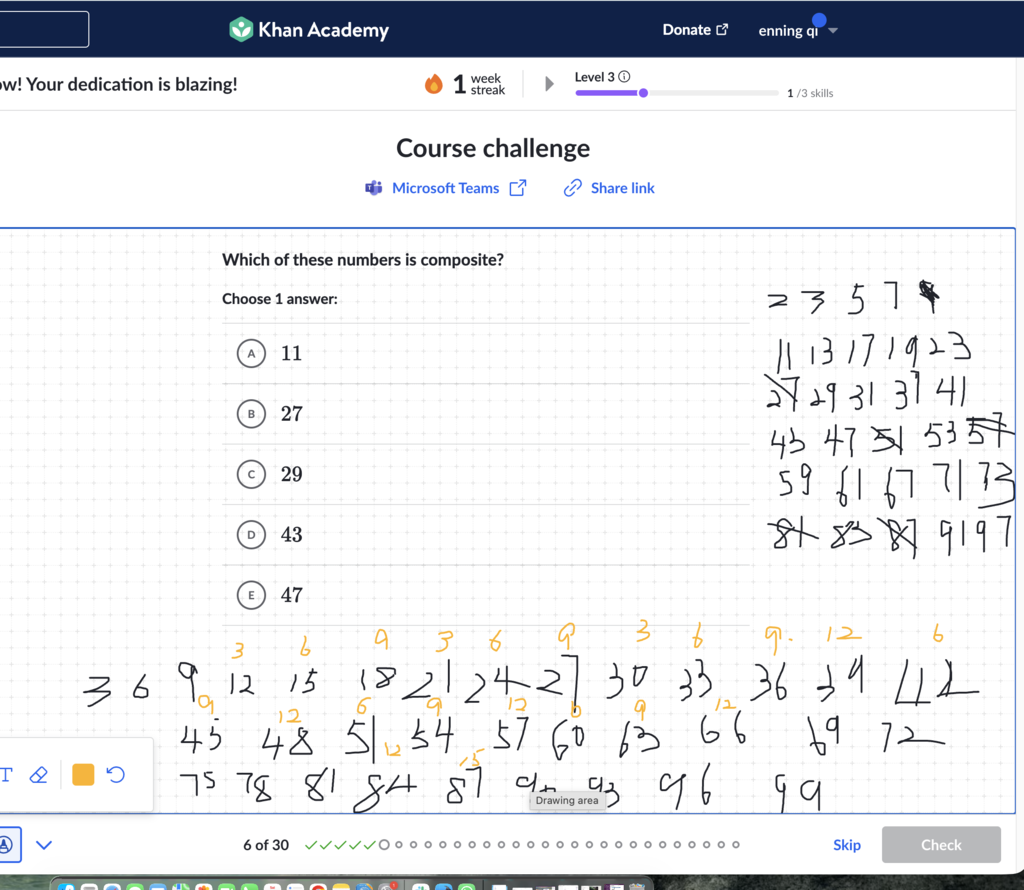
Which of these numbers is composite?
She didn't know the word composite, so she used a dictionary. Then she checked her understanding with Donald. Good.
Donald asked her to write some prime numbers under 100.
She started:
2, 3, 5, 7, 9...
There it was.
Tianjing had done this on her first day. Enning had never done it.
Donald asked her to write all the prime numbers under 100, five per row so they would be easy to count.
“There are a lot,” Enning said.
She produced about six rows.
Then Donald asked her to write all the multiples of 3 underneath and double-check her own prime list.
Enning started smoothly:
3, 6, 9, 12...
She had forgotten the assignment.
“Hey hey, did you forget something?”
She looked confused.
Donald had to remind her:
“Double check your prime number list.”
She went back through the list.
“Oops, 9 is not.”
Donald stopped her from erasing it.
“Keep it there. Just cross it out with a single line.”
Soon she found:
27, 51, 57, 81, 87
For 81:
“Should you punch butt for this one? Does it belong to the times table?”
“9 9 81!”
She laughed loudly.
The mistakes stayed on the paper. The page became a record of understanding rather than a cleaned-up answer sheet.
Later they reached fractions.
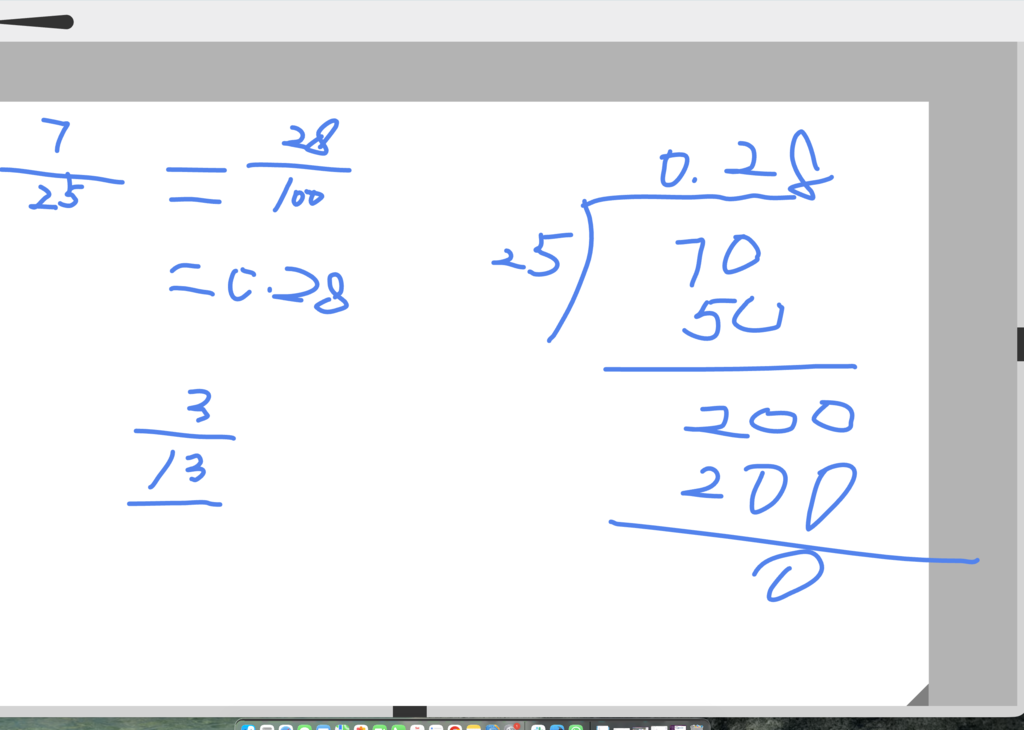
Donald asked Enning not to use division to convert 3/5 to a decimal.
She resisted:
“Not big difference. I used to divide.”
So Donald let her use her preferred method on 7/25.
She got the answer.
Then he made her do it again using the new method.
And then came the gem:
“But it doesn't work for fractions like 3/13.”
Exactly.
Donald agreed:
“You are absolutely right. We only use the trick when we can get tens or hundreds etc. in the denominator.”
For the first time, Enning had discovered the boundary of a method herself.
The old method—division—was general.
The new method was a shortcut that worked under particular conditions.
Then came:
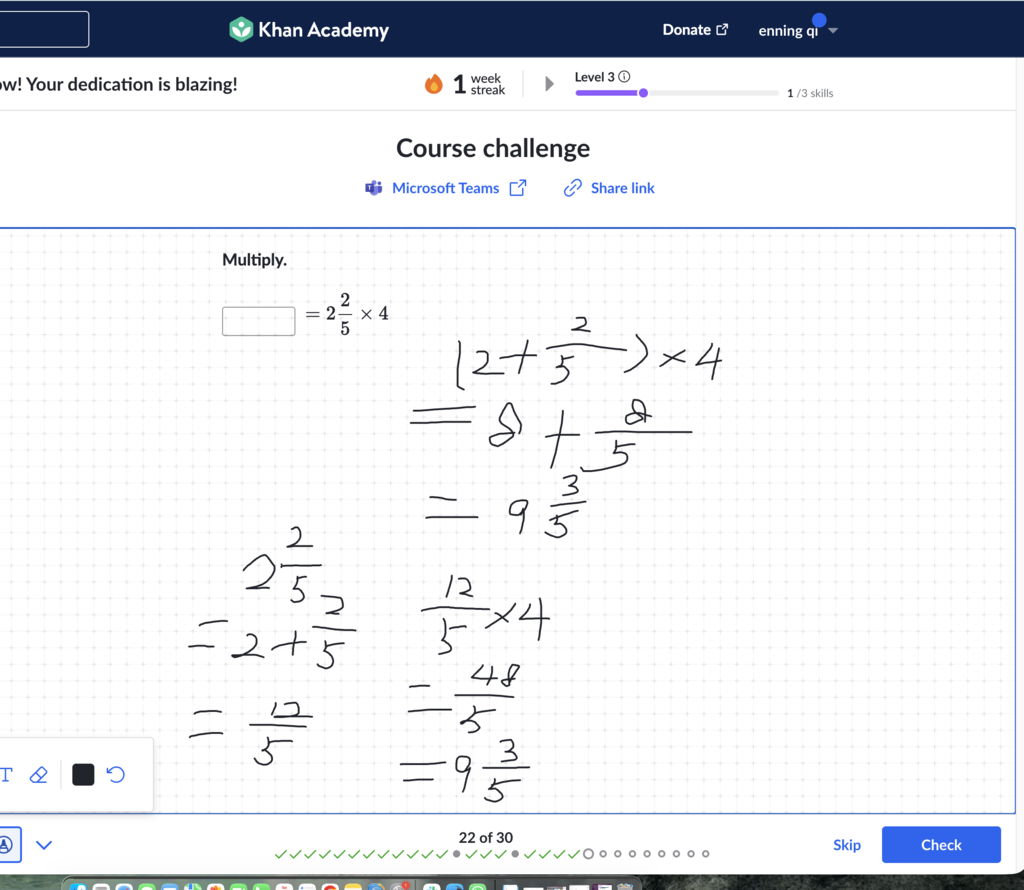
2 2/5 × 4
Enning got the correct answer and, most importantly, understood that the mixed number meant addition:
2 2/5 = 2 + 2/5
Donald asked her to make that addition explicit:
(2 + 2/5) × 4
She could now experience another way of thinking about the same calculation without immediately converting everything into a larger improper fraction.
Today Enning encountered several apparently unrelated problems:
9 is not prime.
81 is 9×9, so it is not prime.
A decimal shortcut works for 7/25, but not for 3/13.
A mixed number is an addition: 2 2/5 = 2 + 2/5.
A complicated-looking for loop can still contain simple ideas that have not been fully understood.
They all point toward the same lesson:
We learn to understand.
Understanding is more than getting an answer.
It means knowing why something works, knowing when it works, and being able to notice when it does not.
Today, Enning did not simply learn several new tricks.
She began learning to question the tricks themselves.
A student who once accepted procedures can learn to examine, test, challenge, and even discover the limits of those procedures.
Slow down. Let the student make mistakes. Keep the mistakes visible. Ask for verification. Let the student discover the boundary instead of announcing it.
Because mathematical maturity is not knowing more tricks. It is knowing when a method applies, why it works, and when to look for another way.