
Living Museum of Learning
Why Wait Until Tomorrow?
Tianjing is 13, and her Grade-4 Khan Academy Math Course Challenge was scheduled for tomorrow.
But why wait if she was ready? LOL
There was another reason I was curious to see how she would do.
Only two weeks ago, when we first met, Tianjing couldn't comfortably read Grade-2 math word problems.
Today, one of the Grade-4 Course Challenge word problems appeared on the screen.
It looked scarily long.
Tianjing became silent.
I waited for a moment, then asked:
“Where? Which sentence or phrase didn't you understand?”
She looked at me and said:
“I understood. I'm calculating.”
😂
Two weeks ago, silence might have meant “I don't understand the problem.”
Today, silence meant:
“I'm thinking.”
And then came a very simple-looking fraction problem:
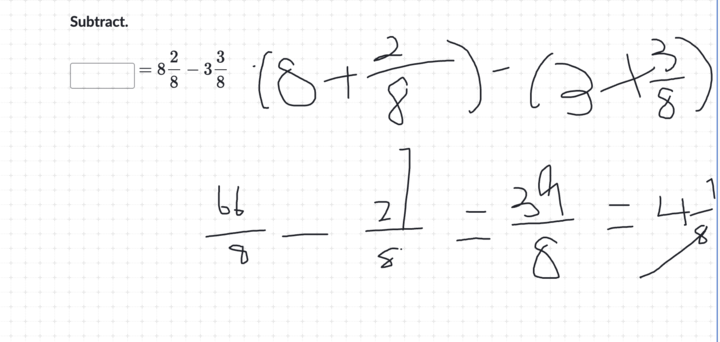
Subtract: 8 2/8 − 3 3/8
Tianjing started without hesitation.
Then I suddenly heard:
“8 8 64...”
Wait.
Why do we need 64?
I stopped her immediately.
I had sensed the smoking gun.
Before Tianjing could explain, I asked:
“Write your calculation on the screen.”
She wrote:
66/8 − 27/8 = 39/8
I said:
“Keep going.”
She continued:
39/8 = 4 7/8
The answer was correct.
But I wasn't interested in the answer anymore.
“Who taught you this way? Or did you teach yourself?”
“I learned it from school, I think.”
“When?”
“I don't know. Maybe around Grade 4?”
😂
Then I said:
“Good. Forget about everything. Now focus on the original problem itself.”
I asked:
“Is it simply 8 pizzas and 2/8 of a pizza, taking away 3 pizzas and 3/8?”
Tianjing got it immediately.
She erased her handwriting even faster than she had written it.
I stopped her again:
“Keep it.”
There was a big problem here.
But I didn't tell her what it was.
Instead:
“Now write above it: (8 + 2/8) − (3 + 3/8).”
She did.
Now her two ways of looking at the same problem were sitting together on the screen.
The beautiful part of today's session was not that Tianjing solved a Grade-4 problem.
It was seeing how much had changed in just two weeks.
A long Grade-4 word problem no longer stopped her because she couldn't read it.
She was silent because she was calculating.
Then, in the fraction problem, another layer appeared.
Tianjing knew a procedure well enough to produce the correct answer, but the procedure had become detached from the meaning of the original numbers.
Her first calculation was not useless.
It was evidence.
The second representation brought the problem back to life:
8 2/8 − 3 3/8
became
(8 + 2/8) − (3 + 3/8).
No mysterious 64.
No unnecessary machinery.
Just the quantities that were actually in the problem.
A learner's silence can mean very different things.
Sometimes:
“I don't understand.”
And sometimes:
“Give me a moment. I'm thinking.”
Learning to tell the difference is part of tutoring.
And a correct answer does not always mean correct understanding.
Sometimes a learner has memorized a procedure so successfully that the original problem disappears underneath it.
One of the tutor's most important jobs is to notice when procedure has separated from meaning.
Make the thinking visible.
Go back to the original problem.
Then let the learner rediscover the meaning.
And when the learner's confusion produces something interesting—
keep it.
It may become useful to someone else.