
Living Museum of Learning
She Cracked 7 7 2 1 in 2 Minutes
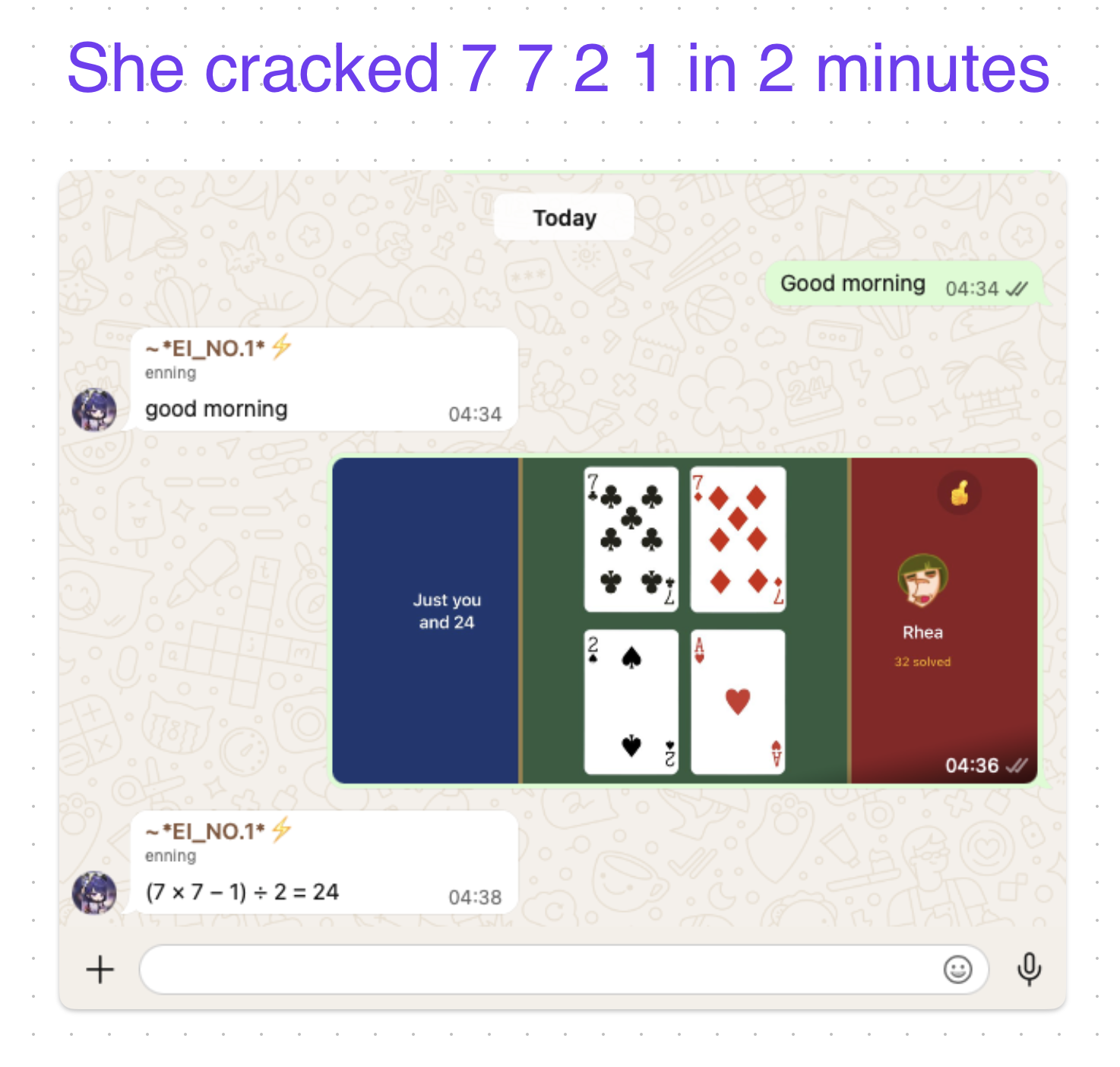
The day before, Cindy worked out a 24 puzzle using the numbers 7, 7, 1, 2 and proudly told me about it.
I had actually saved this particular hand long before Cindy met it.
So the next morning, I posted it to Enning.
I didn't give her a hint.
I simply gave her:
7 7 1 2
And waited.
Less than two minutes later, Enning replied:
(7 × 7 − 1) ÷ 2 = 24
She had used every number exactly once.
No unnecessary steps.
No complicated expression.
Just:
7 × 7 = 49
49 − 1 = 48
48 ÷ 2 = 24
What caught my attention wasn't merely that she found a solution.
It was how cleanly she saw it.
The two 7s create a large number.
The 1 turns it into exactly 48.
The 2 divides it perfectly into 24.
It's the kind of solution that looks almost obvious after you see it—and that's precisely why it is interesting.
Before seeing it, there are many possible operations, orders, and dead ends.
Enning somehow spotted the useful structure very quickly.
And then came the part I loved most.
She didn't just solve the puzzle.
She was proud enough to tell me.
This was the same Enning who, only recently, was discovering why we bother turning arithmetic relationships into algebraic expressions.
Now she was looking at four numbers and instinctively searching for the relationship that makes them work together.
Is Enning weak at math?
Maybe not.
Is she weak at reasoning?
Definitely not.
Perhaps we have been measuring the wrong thing.
Her recent work has shown an interesting pattern.
She may not always recognize a new mathematical notation immediately. She may need time before an abstract idea becomes meaningful.
But once she sees the structure, she can make surprisingly sharp moves.
In the Chinese chessboard project, she moved from concrete geometry to
t = (a - b) / 2
and then extended the algebra herself.
With the star, she went beyond the tiny piece we constructed together and decided:
“I plan to try a few more.”
And now, given 7 7 1 2, she found a clean 24-game solution in two minutes.
Maybe Enning doesn't have the fastest route into every mathematical idea.
But she may have something just as valuable:
the instinct to play with the pieces until the structure reveals itself.
A student who doesn't immediately shine in conventional mathematics can surprise you with powerful structural reasoning.
Give her a small puzzle, enough freedom to explore, and let her discover the relationship instead of prescribing the method.
Because mathematical ability isn't one number—and sometimes the most interesting ability appears in the moment you stop telling a student what kind of thinker they are.