
Living Museum of Learning
Are You Sure?
In TJ's class, Donald taught her int(input()) and let her experiment with the familiar arithmetic operators +, -, *, and /.
Then he gave her two more operators to investigate.
Nobody had taught her what // or % meant.
When TJ encountered %, her first thought was naturally:
“Percent?”
Donald laughed and explained that % had nothing to do with 100 or “percent”—just as * had nothing to do with the stars in the sky. They were simply operators.
He gave her only one hint:
The % operator has something to do with division.
TJ experimented.
After several attempts, she proposed her own explanation:
“It seems that I got remainders.”
Donald did not confirm it.
Instead, he asked:
“Are you sure? Is there any case you tried which failed to be a remainder?”
Now TJ had to do something deeper than recognize a definition.
She had to test a hypothesis.
Later, TJ received a simple homework problem:
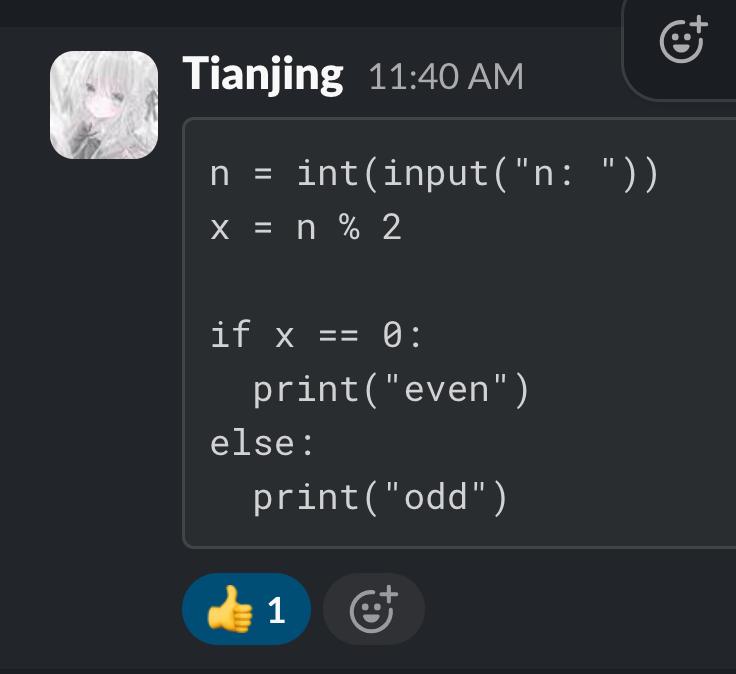
Given an integer, print “even” if it is even and “odd” if it is odd.
Only about half an hour after class, she submitted:
n = int(input("n: "))
x = n % 2
if x == 0:
print("even")
else:
print("odd")
The solution was perfectly done.
Correct logic.
Correct use of %.
No missing pieces.
No unnecessary additions.
And even the spacing was clean and precise.
The operator she had not been taught had become a tool she could independently use.
The most powerful learning sometimes begins with not being given the answer.
TJ first observed the behavior of an unfamiliar operator.
She formed a hypothesis.
She searched for evidence.
She considered whether her explanation could fail.
Then she applied the discovered idea to a new problem.
In less than an hour, the path was:
unknown → experiment → hypothesis → verification → application → mastery
The final homework looked simple.
The thinking behind it wasn't.
A student can discover the meaning of an unfamiliar programming operator without first being given its definition.
Let the student experiment, offer a small hint, and replace “Yes, that's right” with the more powerful question: “Are you sure?”
When students discover and verify an idea themselves, they don't merely remember the rule. They begin to trust their own ability to figure things out.