Living Museum of Learning
"I Trust Your Code."
Nicole had just finished Grade 8. She had already written her own Python Complex class, implementing addition, subtraction, and multiplication. Now she was learning complex division by hand.
Her first problem was:
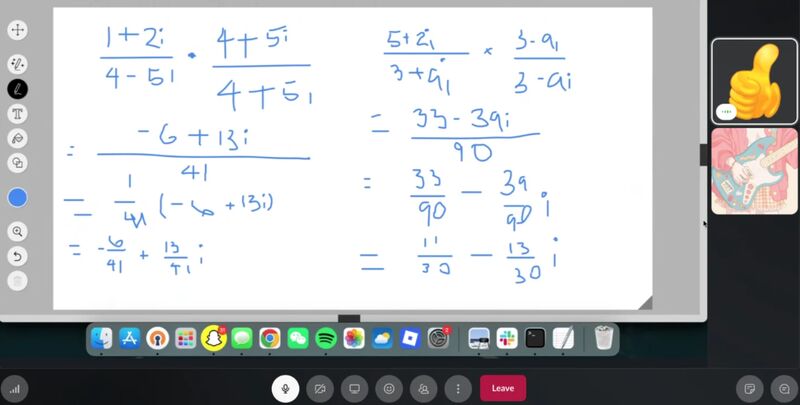
(1 + 2i) ÷ (4 − 5i)
After watching an example, I asked her to solve the problem on the whiteboard.
Instead of multiplying (1 + 2i) × (4 + 5i) by hand, she opened the Python program she had written herself and used it to compute the numerator.
She looked at me, unsure whether she should trust the result.
I smiled and said,
"I trust your code."
That small moment changed the lesson. The program was no longer just a programming assignment—it had become a mathematical tool. Nicole wasn't replacing mathematics with code; she was using mathematics to build software, then using software to deepen her mathematics.
Programming is most powerful when students create tools they can rely on themselves. Writing correct code isn't the end of learning—it's the beginning of thinking with a new instrument.