
Living Museum of Learning
The Inventor Who Forgot His Own Invention
Situation
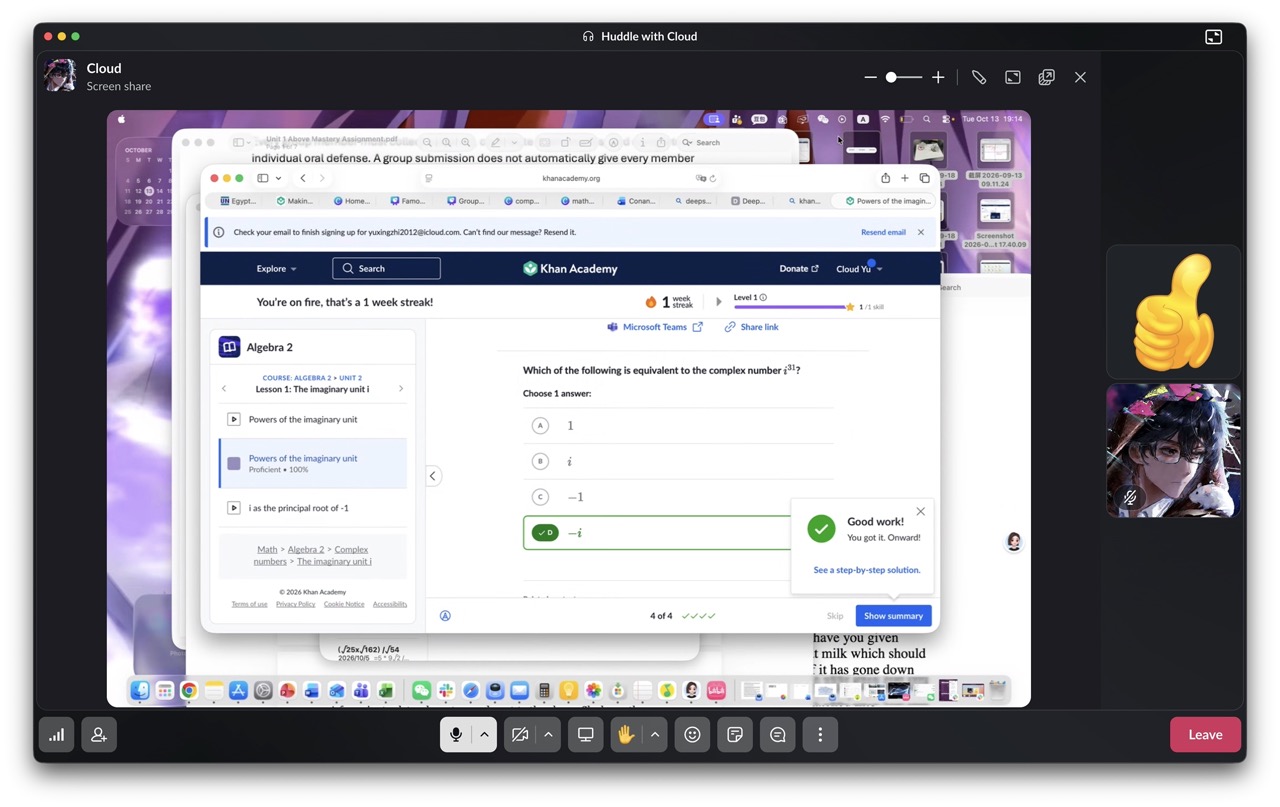
Cloud was practising four questions on Khan Academy.
He had a plan.
After telling Donald the answer, he would deliberately make a mistake. That way, he hoped to earn a fifth bonus question.
It was a clever little strategy. He even announced it in advance.
Turning Point
But then mathematics got in the way.
Cloud had just learned about the imaginary number i. His mind started spinning around powers such as i⁸, exploring the new world that opened up when √−1 became a number.
And somewhere in the middle of all that mathematical excitement, he forgot his own invention.
He made no deliberate mistake.
He got no bonus question.
The inventor had forgotten to use his invention!
Emergence
There was another small adventure that day.
Cloud wanted to fit his lesson into a busy evening, so he arranged to start early and eat dinner around class time.
Donald saw the screen freeze for two minutes.
“Why is it stopped?”
“Oops. Eating.”
Perhaps Cloud was doing mathematics while chewing his food. Perhaps dinner occasionally won the competition for his attention. We may never know.
But we do know that he was eager to attend class, and that a new mathematical idea had captured his imagination.
Learning
We often make plans about what we intend to do. Then something unexpected captures our attention, and the plan disappears.
Sometimes that is a distraction. Sometimes it is curiosity leading us somewhere we didn't know we wanted to go.
Cloud set out to practise four questions and earn a bonus question. Instead, he became absorbed in a new number and its powers.
The bonus question never arrived. But something else had: a reason to keep thinking about mathematics beyond the original exercise.
Perhaps the most interesting part of learning is that we cannot always predict what will capture a student's mind.
And sometimes, the best evidence of that is a forgotten plan.