Living Museum of Learning
From 29 Points by Hand to an Elliptic Necklace in 3D
Situation
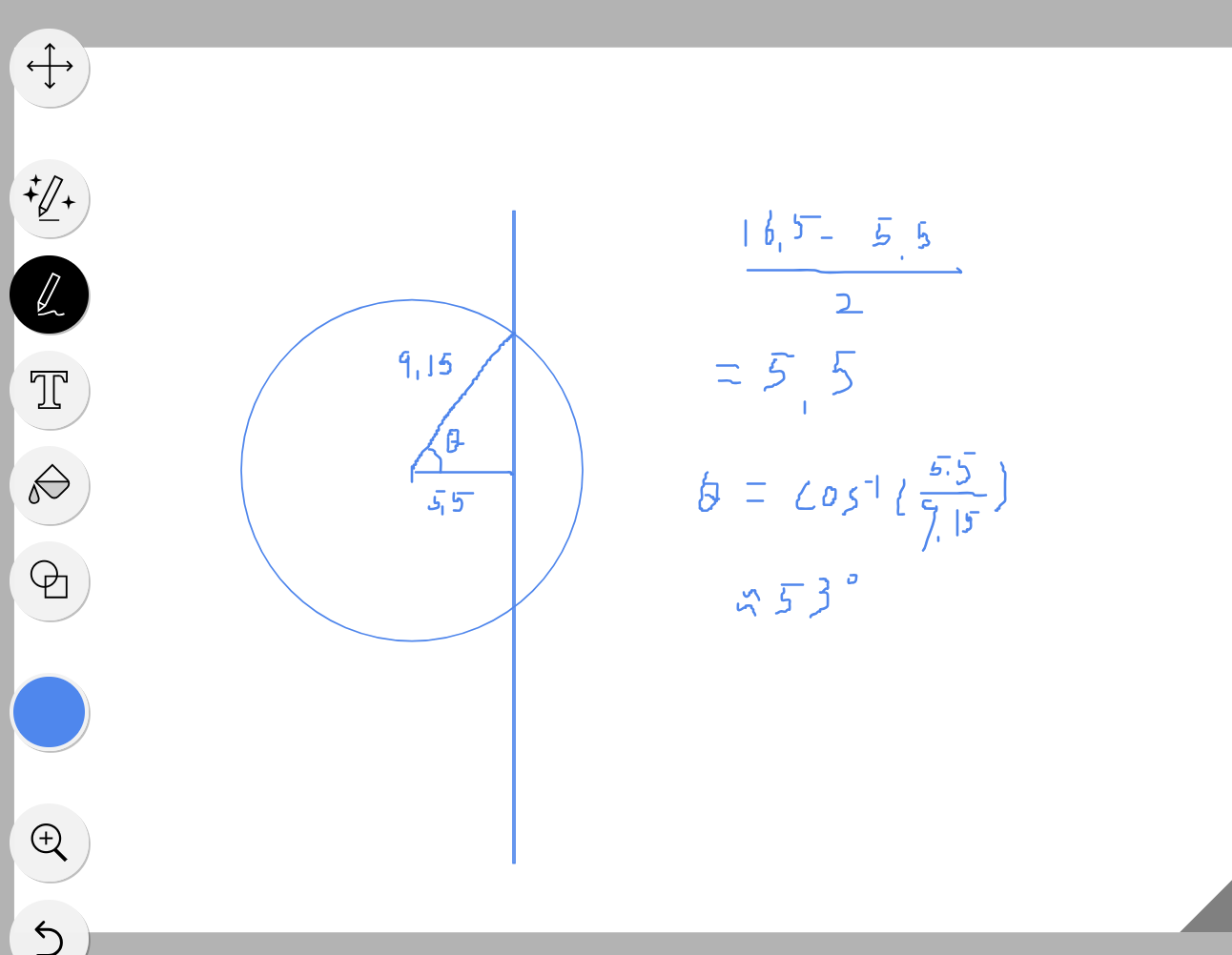
Ethan was working on his soccer court in p5.js. He needed to calculate the arc adjacent to the penalty area, using the measurements 9.15 and 5.5. He worked out an angle of 53°.
Donald went searching for the p5.js API to help him draw the arc. Along the way, he discovered something interesting: the arc() function could draw an arc of an ellipse, not just a circle.
Then Ethan heard a familiar word.
“Uncle, we are learning ellipse in school.”
Donald asked, “What's its equation?”
Ethan began: “a squared bla bla bla b squared ...” LOL.
Years earlier, Ethan had already explored ellipses in a very different way. He used the basic geometric property that the sum of the distances from any point on an ellipse to its two foci is constant. He constructed ellipses manually on paper and later built an iOS app to draw them through code.
In the Living Museum of Learning, that earlier journey had its own exhibit: Ethan's 29 Points by Hand.
Now the ellipse was back, this time through its equation and a new programming environment.
Turning Point
Donald saw an opportunity to take a little detour.
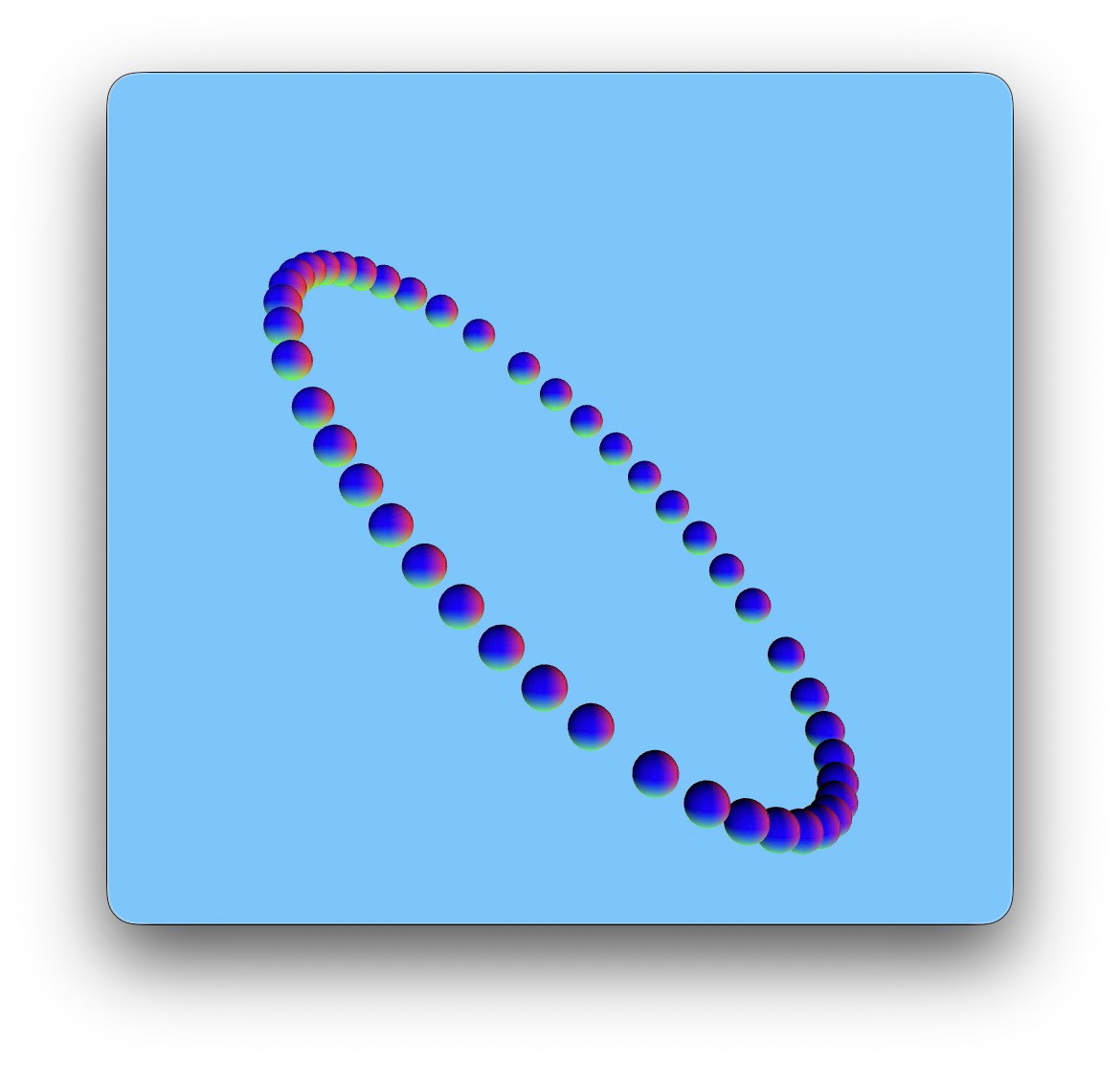
“Ha ha. We can take a pause and make an elliptic 'necklace' floating in the 3D space ...”
The soccer-court task could wait. An old mathematical friend had just opened a new door.
Instead of merely drawing an arc, Ethan would calculate points on an ellipse and use them to construct a three-dimensional object.
Emergence
Ethan wrote a p5.js program using WEBGL.
He defined the ellipse's semi-major and semi-minor axes, a and b, and used the equation to calculate coordinates:
y = sqrt(b*b - (b*b)*(x*x)/(a*a));
He also calculated points from the other direction, using y to find x. By selecting different portions of the ellipse, he placed small spheres along its upper, lower, and side sections.
The result was a necklace made of little spheres, floating in three-dimensional space.
With normalMaterial(), the spheres received 3D shading. With rotateX(), rotateY(), and rotateZ(), the necklace turned continuously. And with orbitControl(), Ethan could explore it from different viewing angles.
An ellipse that once emerged from 29 carefully plotted points now became a dynamic object he could rotate and inspect in a 3D world.
The journey had moved from geometric construction to algebraic calculation, and from a flat curve to a three-dimensional creation.
Learning
One mathematical object, multiple representations: Ethan has encountered the ellipse through its defining geometric property, manual construction, iOS programming, its algebraic equation, and now 3D visualization.
Geometry and algebra reinforce each other: The constant sum of distances to the two foci and the equation of an ellipse offer different ways to understand and construct the same curve.
Mathematics becomes a creative tool: The equation is not merely something to memorize for school. It can generate coordinates that become visible, animated objects.
Programming connects ideas across domains: A practical soccer-court problem led to exploring an API, which led to an ellipse, which led to a 3D necklace.
Learning has a history: Today's work becomes more meaningful when viewed alongside Ethan's earlier achievement, Ethan's 29 Points by Hand. His progress is not simply a collection of new topics; it is the expansion of his ability to use ideas he has encountered before.
Following curiosity creates unexpected opportunities: Donald hadn't planned an ellipse lesson. He was looking for an arc-drawing function. Ethan's connection to school mathematics changed the direction of the session, and a small detour became a new creative adventure.
Theme
Mathematical Continuity
What Is Possible — A mathematical idea can travel from a geometric construction on paper to an iOS app, an algebraic equation, and a rotating 3D object. Each new representation opens possibilities without erasing what came before.
How Does It Happen — Let real projects generate questions. Connect new ideas to a learner's existing knowledge, encourage experimentation, and use programming to make abstract mathematical relationships visible and tangible.
Why Does It Matter — Learning is not a race through disconnected topics. Earlier discoveries become foundations for future creativity. When a learner revisits an old idea in a new context, we can see not just what they know today, but how their understanding and capabilities have grown over time.