
Living Museum of Learning
Leo Finally Became Leo
Situation
For an entire week, Leo had been using Slack with an avatar he had just changed.
There was only one small problem.
He had forgotten to save his display name as “Leo.”
So for a whole week, Leo was technically there—but appeared to be someone else. 😂
The account belonged to a retired Gmail address he had borrowed so that Slack would work in his country.
Yesterday, he finally became Leo again.
And that was also the day he met p5.js for the first time.
Turning Point
I started with almost nothing.
Just the line() function.
I let Leo play with it for a few minutes.
Then I said:
“If you are OK, show me a triangle.”
Leo wrote:
function setup() {
createCanvas(400, 300);
}
function draw() {
background(220);
line(20, 10, 100, 200);
line(100, 200, 300, 200);
line(300, 200, 20, 10);
}
Three lines.
A triangle.
No tutorial.
No step-by-step drawing exercise.
He had been given a primitive and a small challenge. He figured out what to do with it.
Emergence
Leo has never been afraid of a reasonable jump.
So we jumped.
Into 3D.
I asked Leo to name a shape.
He named one.
I gave him a function.
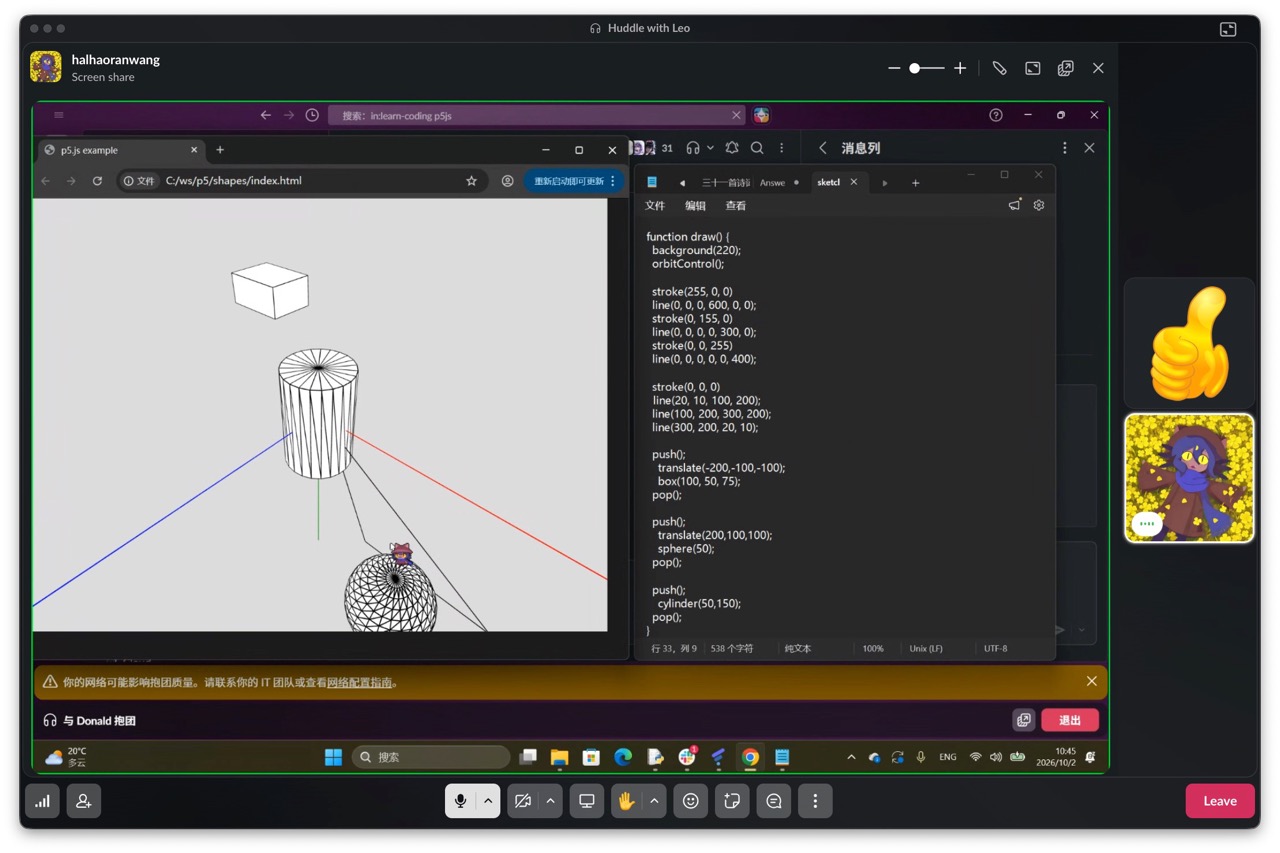
Soon his program contained:
cylinder()
box()
sphere()
3D lines and coordinate axes,
translate(),
push() and pop(),
orbitControl(),
and even a moving cylinder.
The triangle from a few minutes earlier was still there.
Now it was living inside a 3D world.
Learning
There was no need to teach “all of p5.js” first.
Leo learned a tiny piece.
Then he used that piece.
Then we gave him another piece.
Then he combined them.
The progression was not:
lesson → exercise → test
It was:
primitive → creation → curiosity → jump
That distinction matters.
A child who is comfortable making a reasonable jump does not need every step prepared in advance.
Sometimes the best next lesson is simply:
“What shape do you want?”
And then:
“Here is the function.”
Theme
Don't be afraid of reasonable jumps.
What Is Possible?
How far can a learner go when the next step is discovered rather than prescribed?
How Does It Happen?
Give a child a small tool, a small challenge, and enough freedom to make the next jump.
Why Does It Matter?
Because learning doesn't always move one step at a time.
Sometimes three lines are enough to open the door to a whole new dimension.