
Living Museum of Learning
The Bridge Before the Bridge
Situation
For a whole week, Leo was ready to start learning.
The only problem was that we could not get him into Slack.
This was not supposed to be a difficult part of the learning experience. Slack was simply the communication bridge Donald uses with his learners: a place where they can talk, share code, look at each other's screens, and work together.
But Leo's invitation never arrived.
At first, it looked like an ordinary technical problem. We tried the Gmail account Donald had originally created for Leo, but Slack said the email address was already associated with another user. Donald then found another Gmail account that Slack had never seen before.
Two possible paths.
If neither worked, Donald was running out of ideas.
So on September 17, he sent Leo's father, Qing, a longer message—not just asking him to try something, but asking for help investigating the problem.
“如果这两条路径都失败,我暂时就想不出新的尝试方法了。”
“If both of these paths fail, I temporarily can't think of another way to try.”
Donald also started comparing cases.
Cloud in Shenzhen was already using Slack on a Mac.
Ethan and Albert in Zhejiang were using Slack on Macs.
Oliver in Northeast China was using Slack on Windows.
So the evidence did not fit the simple explanation that “Slack just doesn't work in mainland China.”
There had to be another piece of the puzzle.
Turning Point
The problem left Donald's computer and entered a human network.
Qing said he would ask Lao Yu, who had previously helped Cloud's family get Slack working. At the same time, Haiying offered to contact Cloud's father herself.
The next morning, the investigation continued before anyone even tried Slack again.
“我早上给他发了消息,他没回我。”
“I messaged him this morning, but he hasn't replied.”
Then:
“待会我跟他打个电话”
“I'll call him in a little while.”
Haiying called too.
“我给他电话了。”
“I called him.”
She even asked him to reply to Qing.
And finally:
“他回我了。”
“He replied to me.”
Then the most important message of the morning:
“我在跟他讨论”
“I'm discussing it with him.”
Nobody had the complete answer.
But now several people were thinking about the same problem.
Emergence
On September 18, the experiments finally began.
Qing tried a Canadian IP.
The invitation still didn't arrive.
He refreshed.
Still nothing.
He tried a U.S. IP.
Then came another unexpected test: Donald asked him to send a completely ordinary email to Leo's Gmail account.
It arrived immediately.
So email itself was working.
They tried another Slack route using a Gmail address Slack had never encountered before.
A verification code appeared.
Then:
“给了”
“It gave it to me.”
And:
“可以了”
“It works.”
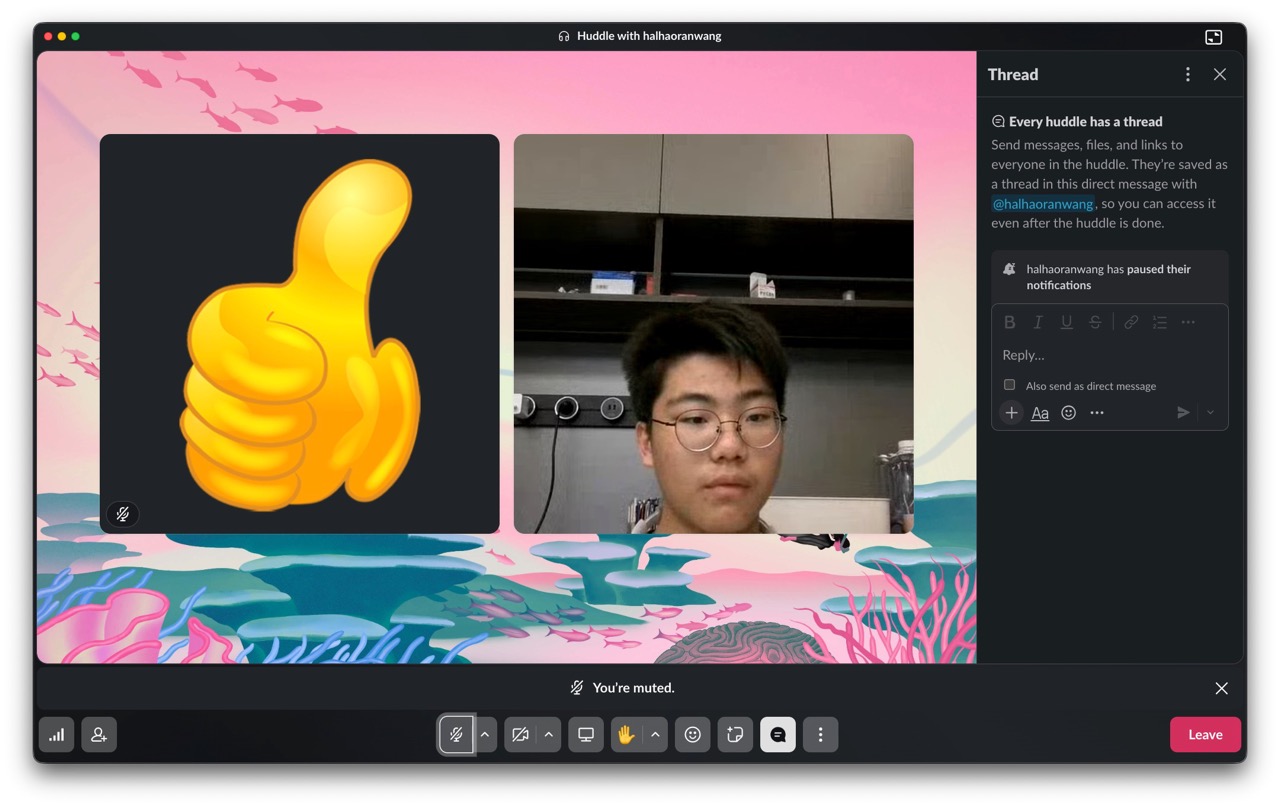
At 9:27, Leo was finally inside.
But that wasn't quite the end.
Slack still needed permissions.
The call notification had to be accepted.
Donald called.
Nothing.
He called again.
Still nothing.
“我再重新呼叫一次”
“I'll call again.”
More permissions.
More screenshots.
More waiting.
At 10:00:
“我又呼叫了”
“I called again.”
And then, at 10:30:
“咱们成功啦!”
“We did it!”
One minute later:
“建立了通讯桥梁!”
“We established a communication bridge!”
Learning
The obvious lesson is about technology.
But that is not the interesting lesson.
Nobody knew exactly what would work.
The successful path was assembled from fragments:
one person's previous experience,
another person's technical guess,
a different IP,
a different email account,
a test message,
a backup plan,
phone calls,
screenshots,
refreshing,
trying again.
The solution emerged through communication itself.
The people trying to solve the Slack problem had to build their own communication network before they could build Leo's communication bridge.
And perhaps that is what makes this story worth keeping.
When a door is closed, the first question does not always have to be:
“Who knows the key?”
Sometimes it is:
“Who else can help us think?”
Theme
Communication · Persistence · Collaboration · Opening Doors
What Is Possible
A technical barrier that seemed immovable for a week can sometimes yield when different people bring different pieces of experience to the problem.
How Does It Happen
Not through one brilliant solution, but through a chain of small experiments, conversations, failed attempts, backup plans, and persistence.
Why Does It Matter
Because behind every technical connection is a human connection. Sometimes building the bridge is itself part of the learning journey.