
Living Museum of Learning
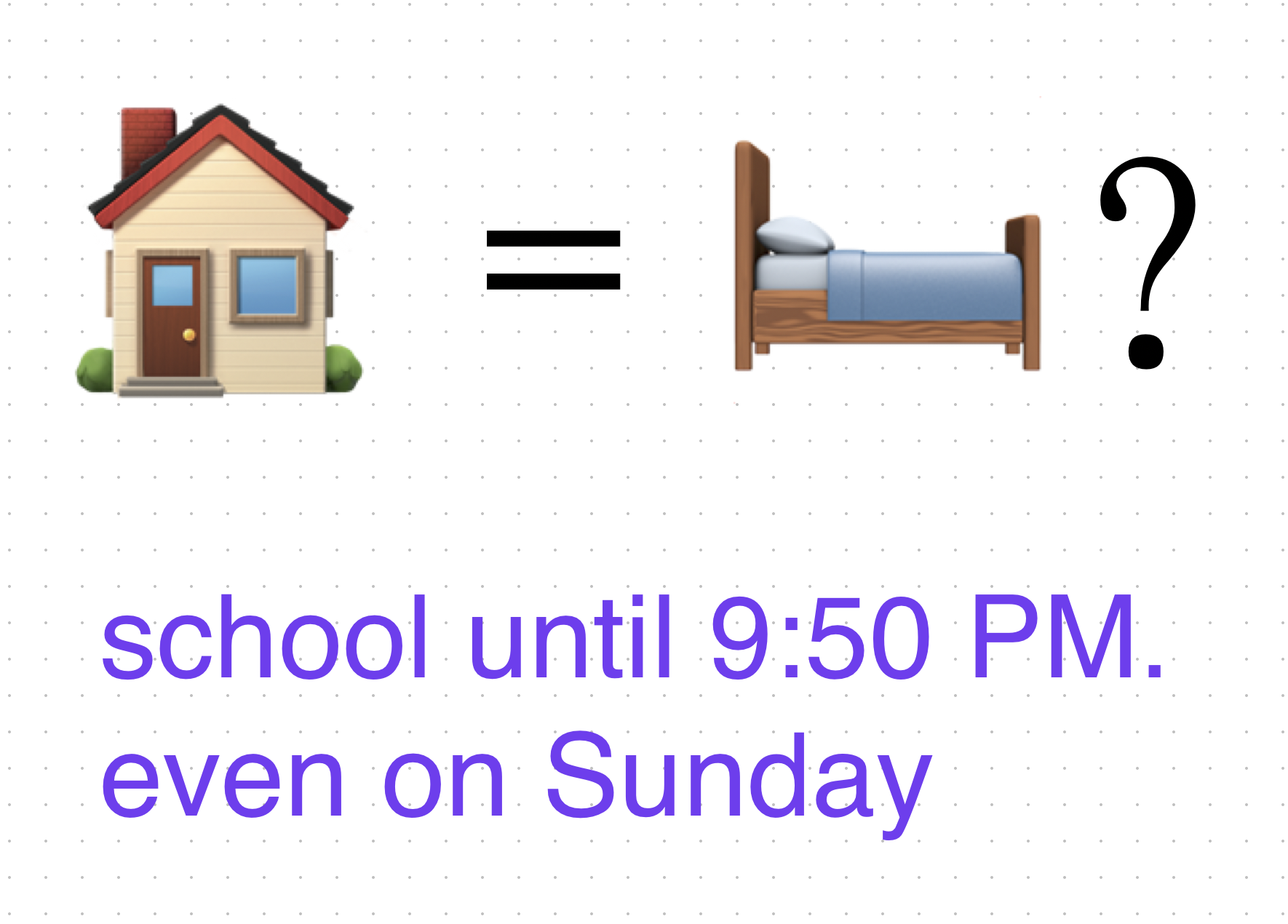
🏠 = 🛏️?
Situation
I was genuinely happy when I learned that Hongyuan wasn't in a boarding school.
He lives at home.
My immediate thought was: wonderful—there should be enormous freedom.
If he wanted to connect after school, we could talk for a while. If an interesting question appeared, we could explore it. On weekends, we could slow down and go deeply into something.
That is how I like learning to happen.
But then I learned his school schedule.
Turning Point
On normal school days, Hongyuan gets up early, goes to school, and doesn't leave until 9:50 PM.
By then, it is already dark.
Six days a week, his public middle school occupies almost his entire day.
Friday is different: he can apparently get home around 6 PM.
Saturday is his one genuinely free day.
And Sunday?
He can sleep late and have lunch at home.
Then, after lunch, he goes back to school.
So “he lives at home” suddenly meant something very different from what I had imagined.
Emergence
I had thought:
住家 = 自由
Living at home = freedom
But if a child leaves home early in the morning, spends almost the entire day at school, and returns at 9:50 PM, what does home actually become?
🏠 = 🛏️?
A home is supposed to be much more than a place to sleep.
And this particular child makes the contrast especially painful for me.
Hongyuan is a wonderful learner and thinker.
In our very first conversation, a simple 24-point card game was enough to get him thinking, calculating, communicating, switching into English, noticing a mistake, and correcting himself.
He reads philosophy.
He likes challenging ideas.
He doesn't seem to need adults to manufacture curiosity for him.
He needs time.
If he didn't have to stay at school until 9:50 PM, I wouldn't be thinking about squeezing a 15-minute or 30-minute conversation into the end of his day. We could have much more room for spontaneous conversations, projects, mathematics, programming, philosophy—or simply following whatever question happened to catch his attention that day.
So I asked his father:
“你从来没考虑过跟学校申请不参加学校的晚自习吗?”
“Have you ever considered asking the school if he could be exempted from the evening study?”
Learning
More than twenty years ago, when I returned to China to start a business, my daughter was in middle school in Shanghai.
Her school required everyone to copy English vocabulary words ten times each.
I didn't simply accept it.
I went to the homeroom teacher.
Then I went to the principal.
I explained that she had come from Canada and asked whether her daily vocabulary-copying assignment could instead become a short English composition.
They agreed.
My daughter was “解放”了.
She wasn't freed from learning.
She was freed for learning.
That experience has stayed with me.
Today, when I look at Hongyuan's schedule, I have the same question again:
Does all of this really have to be this way?
I don't know whether his school will allow a different arrangement.
I don't know what Hongyuan himself will want.
But I think the question is worth asking.
Because education isn't only about what we teach a child.
It is also about how much of the child's own time remains available for being a person, a thinker, a creator, and simply himself.
Perhaps the first door I can help open for this learner isn't a door into mathematics.
Perhaps it is a door into his own time.