
Living Museum of Learning
The Day a Curve Appeared
One day earlier, Tianjing had connected a linear equation to a line of dots on a Python Turtle window.
The next day, instead of giving her another formula to memorize, I asked:
“What will it look like if you run your Python code with y = x?”
She predicted a horizontal line.
Her own program proved her wrong.
Then came y = 2*x.
She predicted that it would be lower than y = x.
Wrong again. 😂
For a beginner, equations were still something to imagine rather than something she could see.
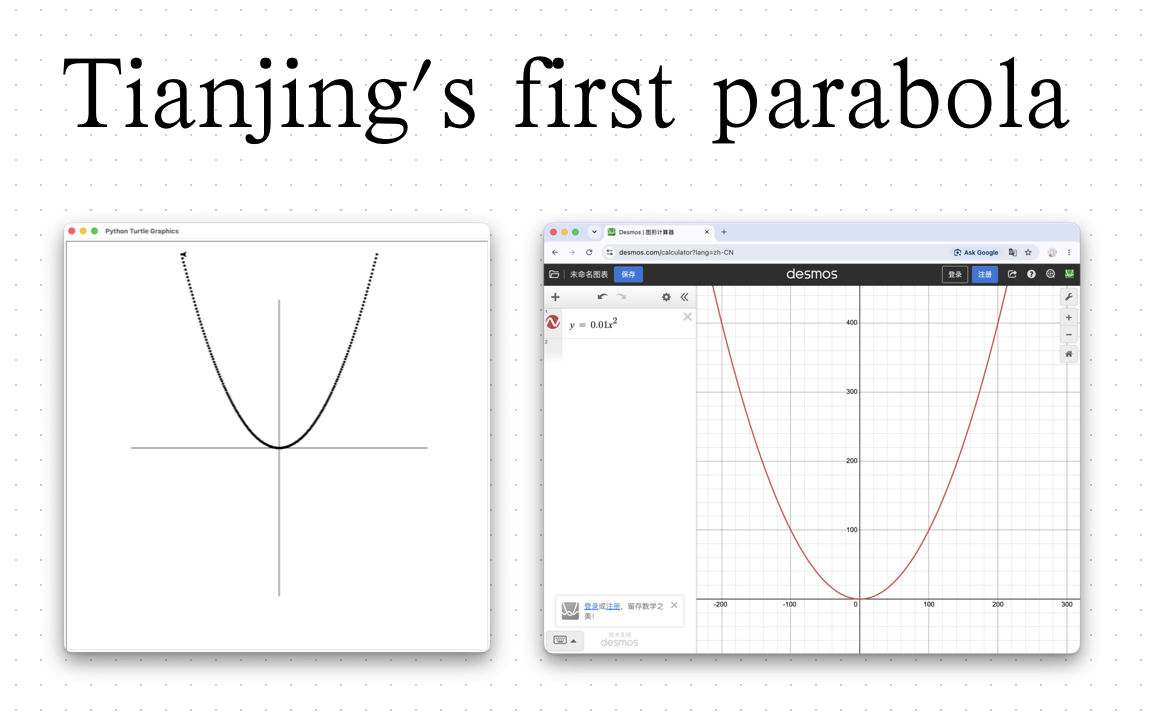
Then I asked her to manually plot y = x².
This time, she got it.
“Not a straight line. Bent this way.”
Then she looked at the other side.
“Wow, the other half is symmetric.”
She had just noticed a fundamental property of the parabola before being given its name.
The two arms of her parabola were too close together, so we experimented.
y = 0.5*x*x
Then:
y = 0.01*x*x
Tianjing began to see that changing the equation changed the shape.
She wasn't memorizing what a parabola was supposed to look like.
She was making one.
Once she was comfortable with her beautiful curve of dots, I finally gave her a chance to compare it with Desmos.
She zoomed in and out until the Desmos curve matched her own.
The computer was no longer showing her the answer.
It was confirming what she had discovered.
Near the end of the 1.5-hour class, I asked one more question:
“What do you think y = x³ will look like?”
She thought for a moment.
“Similar to y = x².”
This time I answered directly:
“It's very different.”
And I left her with that confusion.
After class, her homework arrived:
HW1: Learn exponent calculation in Khan.
HW2: Investigate the curve of y = x³.
Then came one more challenge:
“Could you try your best to learn as much as possible UNIT 1 of 8th grade math in Khan?”
Tianjing's answer was wonderfully simple:
“ok”
The parabola had not been the conclusion.
It was the beginning of the next question.
A mathematical equation can begin as something mysterious on a page.
Then you make it visible.
You predict.
You test.
You get it wrong.
You look again.
You change the equation.
You discover symmetry.
You adjust the scale.
And eventually, the symbols begin to describe something you can actually see.
Tianjing did not memorize a parabola.
She met one.
A beginner can develop mathematical intuition by experimenting with equations instead of memorizing their shapes.
Let the student predict, let the program challenge the prediction, and let observation lead the next question.
Because when equations become things a student can see, manipulate, and discover, abstract mathematics begins to feel real.