
Living Museum of Learning
The One-Pixel Mystery
Enning was working on Grade 6 Khan Academy math, but instead of rushing forward, we deliberately went back to Grade 5 fractions.
Division and fractions still had some holes. I introduced a simple but unfamiliar trick: whenever she saw "÷", replace it mentally with the long horizontal fraction bar. This made the numerator and denominator visible and made cancellation easier to understand.
But even a simple visual change took time. Crossing out a "2" and crossing out a whole "1/2" were not the same thing to her yet. I slowed down and showed her carefully.
Then I told her:
"No rush. Being unable or unfamiliar isn't too bad. The worst is leaving holes and moving on. The holes will revenge in a later time."
We laughed about how a missing multiplication table could eventually come back to haunt us while shopping.
Then we switched to something much more exciting: 3D coding in p5.js.
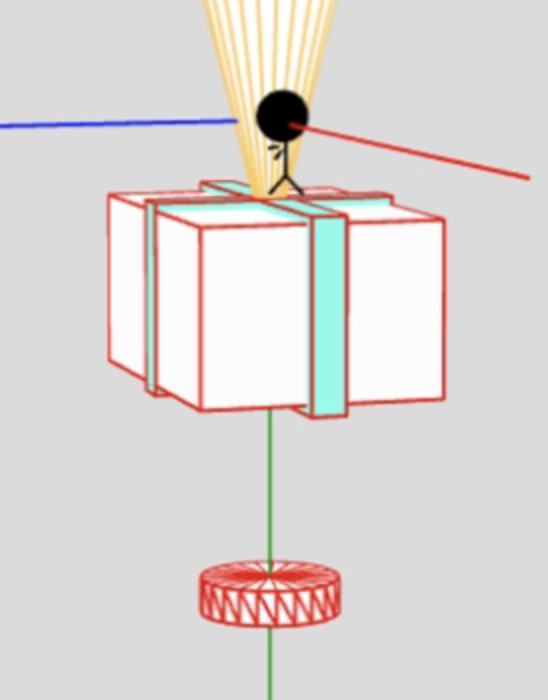
Enning had created an ice cream combo the day before. While examining her code, we noticed a cylinder that appeared nowhere in the visible result.
"Where is your cylinder?"
"Maybe hidden inside the box?"
She wasn't sure.
Then she remembered that the cylinder had originally been intended as an ice-cream base, but she later discovered that a box made a better base. The cylinder had simply been forgotten.
Instead of deleting it, we turned the forgotten cylinder into our experimental object.
"How can we move it out automatically?"
She reused the ideas from her earlier 3D code and made the cylinder move.
Then it kept moving farther and farther down.
"Can we bring it back at some point?"
She added an if statement and a number to control its movement. The cylinder could now escape and come back.
"Come back, don't escape!"
She laughed.
A forgotten piece of code had become a moving object, and a moving object had become a small experiment in controlling behavior.
Then Enning brought back a mysterious problem from the previous day: a strange flickering "band" hanging around her 3D ice cream.
We started investigating instead of guessing.
We hid one band. It still flickered.
We hid two. Still flickering.
Maybe one surface was too close to another surface?
We experimented with the distance between them.
Ten pixels apart: no flickering.
Then we searched for the extreme case.
Closer.
Closer.
Closer.
Finally, we discovered something surprisingly precise:
A difference of just one pixel was enough to stop the flickering.
The mysterious visual bug was no longer mysterious.
Two surfaces occupying essentially the same position were fighting to be displayed.
The "bug" had turned into an experiment with a measurable boundary.
And Enning had not merely been given the answer. She had helped discover it.
This class was really about much more than fractions or p5.js.
In math, we slowed down because an unfamiliar idea is not a problem, but an invisible hole can become a problem later.
In programming, we reused working code instead of starting from scratch.
In debugging, we did not immediately accept a guess. We changed one thing, observed what happened, formed another hypothesis, and kept narrowing the possibilities.
The same habit appeared in three different forms:
Don't rush past what you don't understand.
Make the invisible visible.
Experiment instead of guessing.
A forgotten cylinder became an experiment.
An escaping cylinder became a lesson about conditions and repeated behavior.
A flickering band became an investigation.
And a one-pixel difference became evidence.
Perhaps the most important learning was not "how to make an object move."
It was learning that when something doesn't make sense, we don't have to be afraid of it.
We can slow down.
We can ask questions.
We can change one thing.
We can observe.
We can try again.
And sometimes, after enough experiments, we discover that the answer was hiding in something as small as one pixel.
A forgotten cylinder can become a moving object. A moving object can become a controllable system. A mysterious flicker can become a measurable experiment. Even a one-pixel difference can reveal a hidden rule.
Slow down instead of rushing past holes. Reuse working ideas. Turn questions into experiments. Change one variable at a time. Observe the result. Keep narrowing the possibilities until the mystery becomes understandable.
Learning is not about never being confused. It is about becoming comfortable with confusion. Holes that are ignored can return later, but holes that are investigated can become foundations. The courage to slow down, experiment, and be wrong is one of the foundations of creativity and independent learning.