
Living Museum of Learning
Secret of Teaching: No Secret
If visitors to the Living Museum of Learning ever ask:
“How does Donald design his teaching? Why does he sometimes look like a magician?”
Here may be the answer.
There is no secret technique.
No magic formula.
Often, Donald simply looks for something that the kid already knows and Donald also knows deeply.
A game can be enough.
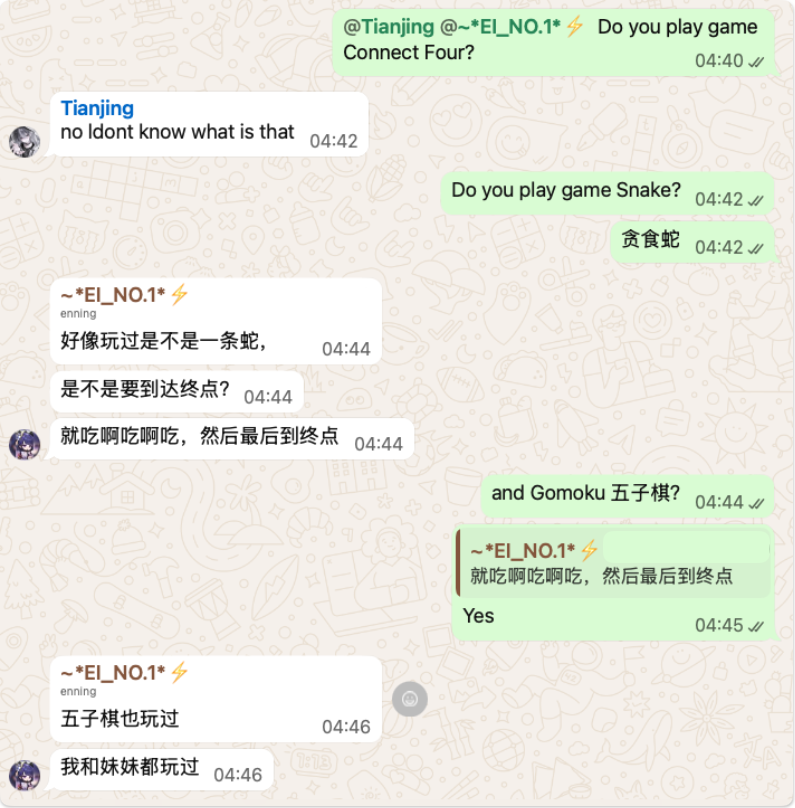
On August 21, 2026, Donald casually asked Tianjing and Enning:
“Do you play Connect Four?”
Tianjing didn't know it.
Then Donald asked about Snake.
Enning immediately recognized it:
“好像玩过,是不是一条蛇?”
She reconstructed the game from memory:
“就吃啊吃啊吃,然后最后到终点。”
Then Donald asked about Gomoku—五子棋.
Enning replied:
“五子棋也玩过。”
And then came the most useful piece of information:
“我和妹妹都玩过。”
At that moment, the common denominator appeared.
Donald already had an iOS Gomoku / Snake project.
The kids already knew the games.
This is one of Donald's simplest teaching tricks:
Start from something that already belongs to both sides.
The child approaches the game as a player.
Donald approaches the same game as a builder.
The child knows:
“I play this.”
Donald can ask:
“How does it actually work?”
Then the questions naturally appear:
What is the board?
What is a cell?
How do we represent a move?
How does the snake remember where its body is?
How do we decide whether five pieces are connected?
How does the computer know whose turn it is?
What happens after every move?
And eventually:
“Can we make our own?”
Now programming is no longer an abstract subject being taught to the child.
The child is trying to build something she already understands.
That is where the magician apparently appears.
But there is no magician.
There is simply a shared object between the teacher and the learner.
Donald should remember this.
When Rhea someday comes to Grandpa and says:
“Grandpa, can you help me?”
the first question may not need to be:
“What should I teach you?”
It may be:
“What do you already love to play with?”
A game, a Lego creation, a drawing, a story, a puzzle, an app, a toy—anything that already lives in the child's world can become the bridge.
The teacher does not have to pull the child into the teacher's world.
Build a door between the child's world and your own.
Sometimes the door is called Gomoku.
Sometimes it is Snake.
And sometimes, for Rhea, it may be something Grandpa hasn't discovered yet.