
Living Museum of Learning
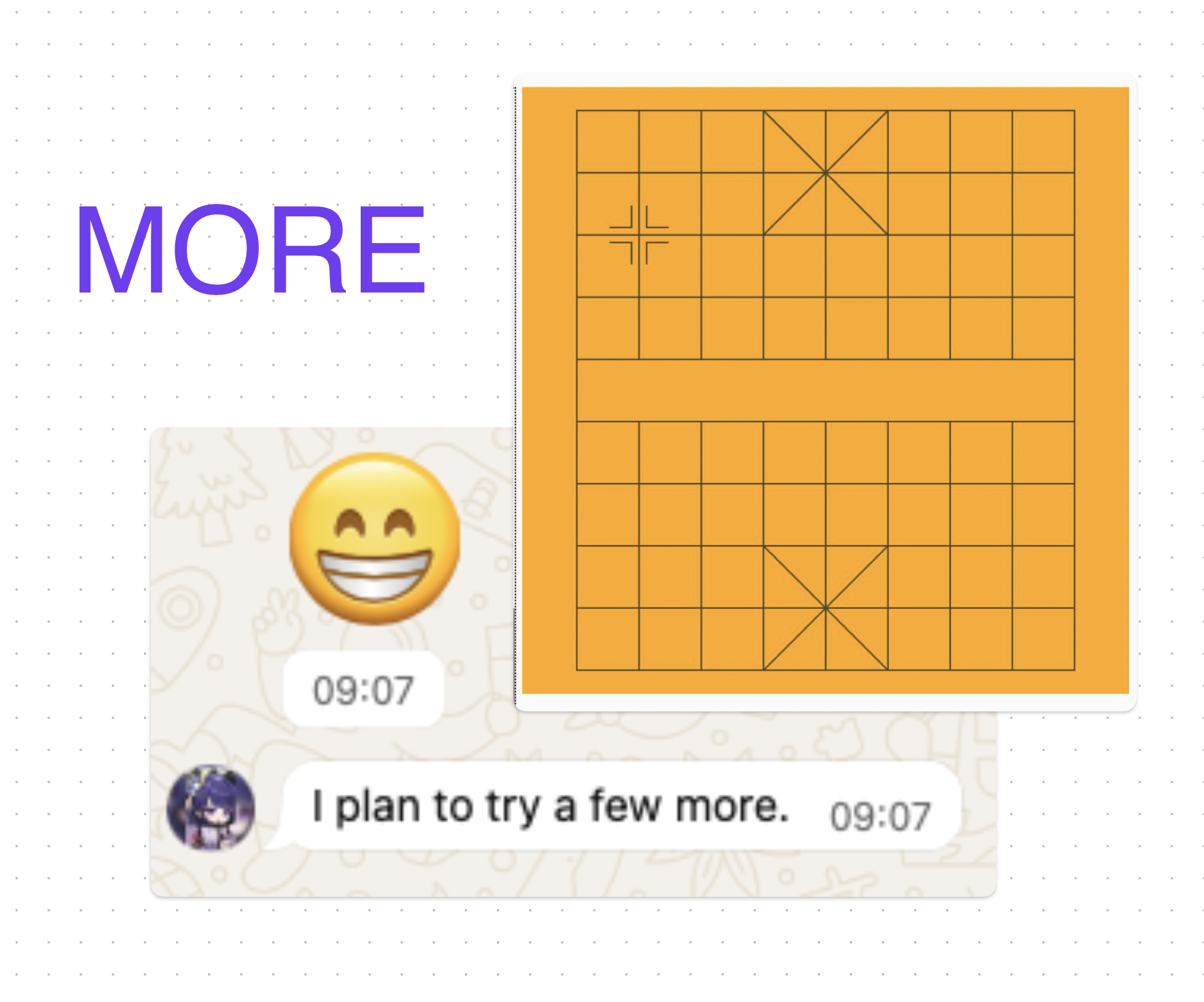
“I Plan to Try a Few More.”
The morning class had ended with a very small assignment.
We had worked together on the first 1/8 of the first star on our Chinese chessboard. I showed Enning how three simple lines could describe a small piece of the geometry, and we spent a long time examining the meaning hidden inside them.
Then I told her:
“Draw your first star on the Chinese chessboard.”
That was it.
No requirement to finish the whole board. No requirement to draw more stars. Just one star.
A little while after the class ended, Enning submitted her homework.
She had gone far beyond the small piece we had drawn together.
She recognized the symmetry and constructed the horizontal and vertical pieces in different directions, using gap and s to control their positions and lengths.
The result was no longer my demonstration.
It was becoming her board.
I replied:
“Well done 👍”
Enning answered:
“I plan to try a few more.”
I immediately replied:
“That’s even better.”
This was the surprising moment.
The homework had already been completed.
But she wasn't finished.
She had decided, on her own, to continue.
The important thing that emerged was not another star.
It was desire.
During the morning class, I was the one asking questions, giving challenges, and pushing the next step.
After the class, that structure disappeared.
Enning was alone with the code.
And instead of waiting for the next instruction, she looked at what she had made and thought:
“I want to try a few more.”
That tiny sentence marks a significant change in the relationship between student and project.
The teacher's assignment became the student's exploration.
There is a difference between finishing an assignment and wanting to continue after finishing it.
The first demonstrates compliance.
The second reveals curiosity.
Enning's code also shows something important about how that curiosity is developing. She did not simply copy the single 1/8 star we constructed together. She extended the geometric idea herself, using symmetry, positive and negative offsets, and repeated coordinate relationships to build the rest.
The code is still wonderfully imperfect.
She has not yet turned the repeated lines into a loop or another abstraction. That's fine.
Right now, she is doing something more fundamental:
seeing the pattern.
The abstraction can come later.
First comes the moment when the student notices:
“Wait... I can make another one.”
And then:
“What if I make a few more?”
A small programming assignment can become the beginning of a student's own exploration.
Give just enough structure to get started, then leave enough space for the student to take ownership.
Because the most valuable homework submission may not be the finished work. It may be the sentence: “I plan to try a few more.”