
Living Museum of Learning
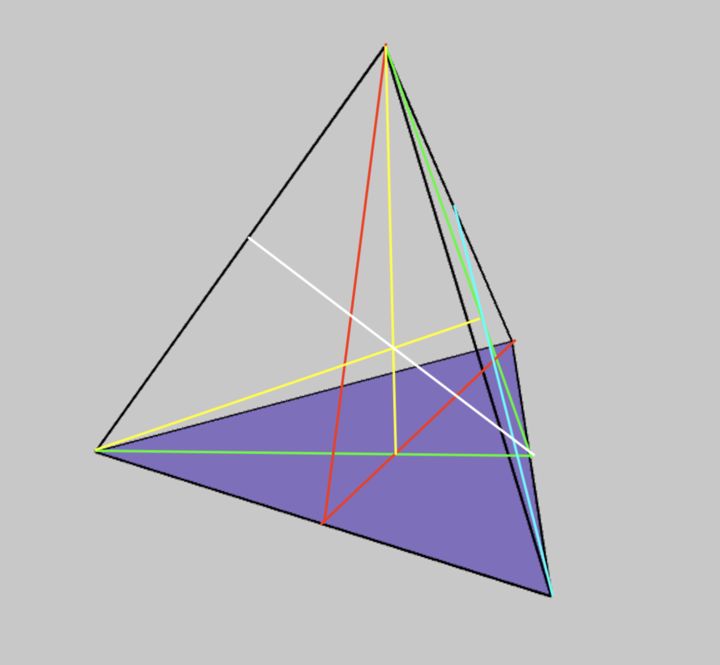
Albert and the Potato
Albert was exploring the symmetries of a regular tetrahedron.
Together, we used group theory to clear away one small but stubborn corner of its geometry.
After the discussion, I smiled and said:
"You just peeled away a tiny layer of mystery. What a magical experience to share."
Albert laughed and replied:
"I feel like smashing a potato." 🥔
Then added:
"Or an eraser." 😆
His mom, listening nearby, couldn't help asking:
"I really want to know what this potato thing is about!" 😂
Albert explained:
"It's about the regular tetrahedron — because we didn't have one at home." 😅
Sometimes mathematics begins with whatever is available.
A potato.
An eraser.
Anything that can stand in for a solid you don't yet own.
Later, I reminded Albert that Lucas had taken a different approach.
Instead of carving a physical model, he captured a frame from his rotating animation and added construction lines digitally.
I joked:
"Our research group can model with math and code, saving quite a few potatoes (and erasers)." 🥔✏️
Then we returned to mathematics.
The next challenge was to explore the reflection symmetries, complementing the rotational symmetries he had already understood.
Mathematics doesn't depend on expensive equipment.
It grows from imagination.
When the ideal model isn't available, curious learners invent one.
Sometimes it's software.
Sometimes it's a sketch.
Sometimes...
it's a potato.
Abstract ideas can be explored with everyday objects and a playful imagination.
Students move naturally between physical models, digital models, and mathematical reasoning.
Joy and curiosity make even advanced mathematics feel approachable—and memorable.
Sometimes... it's a potato.
Because years from now, Albert probably won't remember every permutation in the symmetry group.
He will remember the potato. And that memory will bring the mathematics back with it. That's wonderful teaching.