
Living Museum of Learning
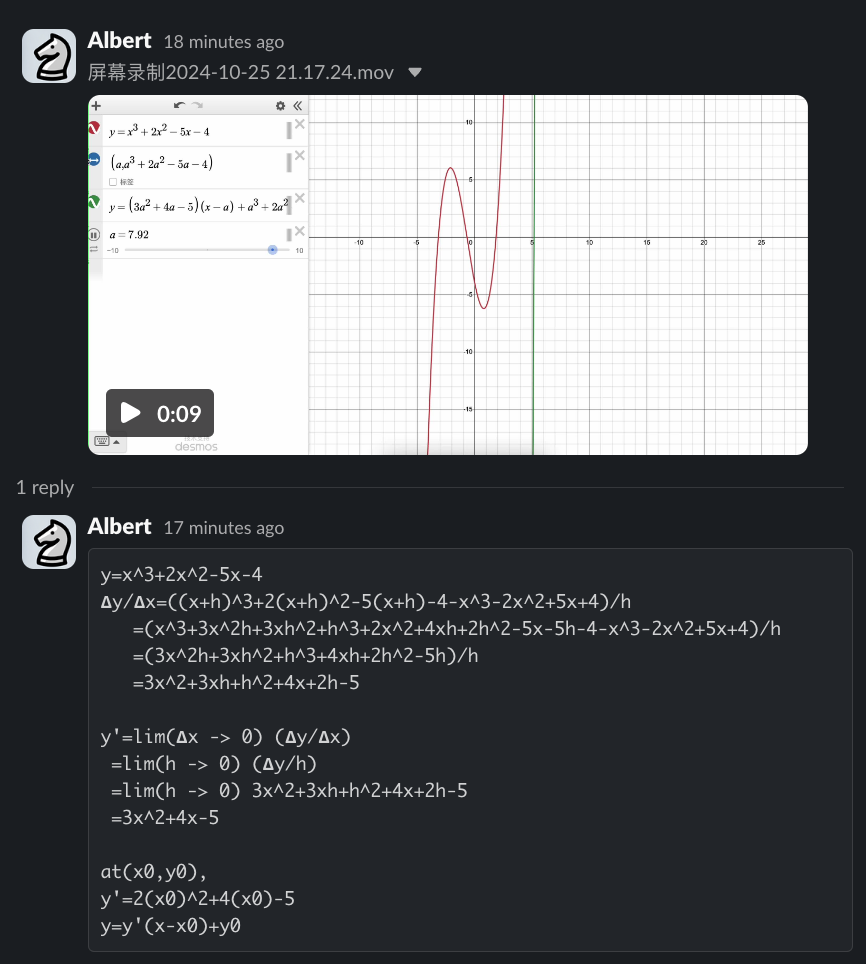
Albert's First Limit
Every learner has a moment they never forget—
the first time a difficult idea suddenly makes sense.
For Albert, that moment came in Grade 9, when he met the concept of a limit.
Starting with
y = x³ + 2x² – 5x – 4,
he patiently expanded the difference quotient by hand, simplifying it step by step until only one question remained:
What happens as h approaches zero?
After canceling terms and simplifying, Albert arrived at
Δy/Δx = 3x² + 3xh + h² + 4x + 2h – 5
Taking the limit as h → 0 gave
y′ = 3x² + 4x – 5.
The algebra was complete.
But the idea was just beginning.
Albert then opened Desmos.
He created a point on the curve.
He drew its tangent line.
Then he pressed Play.
The point moved.
The tangent glided smoothly along the curve.
For the first time, the derivative was no longer just a formula.
It became something he could watch.
Many mathematical ideas begin as symbols on paper.
The deepest understanding often comes when those symbols begin to move.
A limit is no longer merely a calculation.
It becomes the bridge between motion and change.
For Albert, that bridge first appeared on a screen—and has stayed with him ever since.
A seemingly abstract idea can become intuitive when mathematics becomes interactive.
Careful symbolic reasoning, followed by visualization, transforms calculation into understanding.
The first time a major concept truly "clicks" often shapes how a student feels about mathematics for years to come.
The curve danced. The tangent slid.