Living Museum of Learning
Never Guess
Oliver, a Grade 7 student, had already been a sanda (Chinese kickboxing) champion in his hometown for several years before joining my classes.
One day I introduced him to Sudoku.
Not the easy puzzles.
The hardest ones on sudoku.com.
Our agreement was simple:
Never guess.
Never use hints.
Never use the note tool.
Solve everything in your head.
Reasoning only.
Oliver quickly progressed through the easier levels.
Soon he stopped playing them altogether.
For both Classic Sudoku and Killer Sudoku, he settled almost exclusively on the highest difficulty:
Extreme for Classic.
Expert for Killer.
The puzzles often reached a point where nothing obvious remained.
After several quiet minutes, Oliver would ask:
"Uncle Donald, did you see anything?"
Or:
"Any breakthrough?"
Sometimes I smiled.
"We're lucky. There's a direct one."
A moment later:
"I found another."
Then:
"Hurry—there's a whole chain of direct deductions."
Reasoning has momentum.
Once the first domino falls, the next often becomes visible.
Eventually only a handful of difficult cells remained.
I might say:
"Okay, we've eliminated four possibilities."
Or:
"I found one—but this one isn't direct."
One memorable puzzle reached exactly that stage.
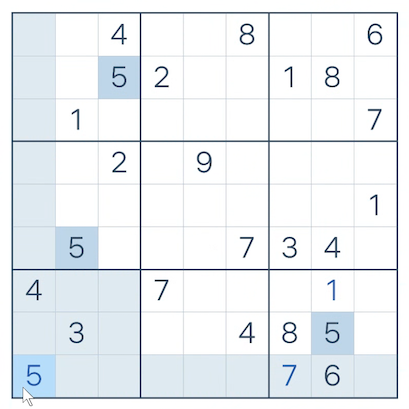
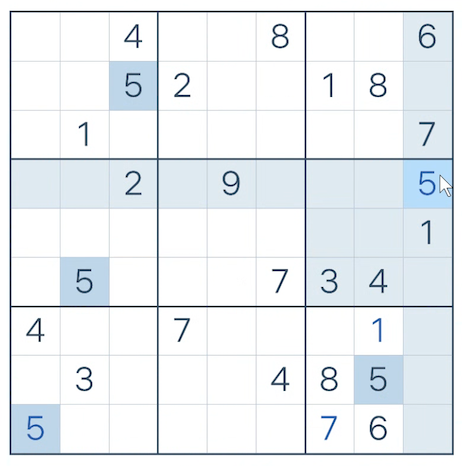
The remaining 5 refused to appear.
A few minutes later, Oliver suddenly saw it.
Not by inspiration.
Not by guessing.
He first recognized the two remaining positions for the digit 5 in a row and a column.
That structural observation squeezed the final answer out of the grid.
The puzzle yielded because the logic had become complete.
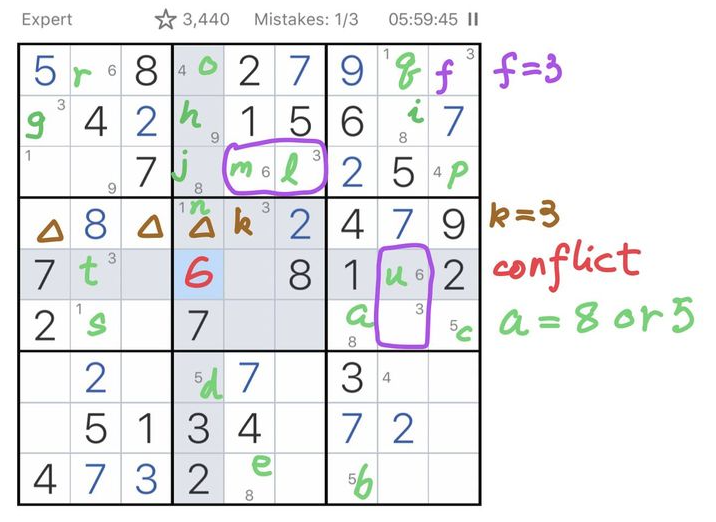
Years earlier, I had spent nearly six hours solving a single Sudoku puzzle on my phone while waiting in a shopping mall.
Rather than keeping only the solution, I recorded the journey.
Cells were labeled:
a, b, c ... all the way to t.
Each letter marked a turning point in the reasoning.
The finished puzzle was interesting.
The path toward it was far more valuable.
That screenshot later became something I could share with students—not as an answer key, but as a map of how reasoning unfolds over time.
Many people think Sudoku is about filling numbers.
It is not.
It is about building certainty.
Our classroom rule never changed:
Never guess.
Every number deserves a reason.
Every conclusion should follow from the previous one.
Sometimes the path is short.
Sometimes it takes six hours.
Either way, the joy comes from the same place:
Watching uncertainty slowly disappear under the weight of logic.
The hardest Sudoku puzzles can be solved without guessing, hints, or candidate notes.
Each deduction creates the conditions for the next, allowing certainty to grow one step at a time.
Learning to trust reasoning over guessing builds habits that extend far beyond Sudoku.