
Living Museum of Learning
Lucas, the Shuffle, and the Case of the Missing Card
Lucas began programming in Grade 2 and had been coding for several years by the time he reached Grade 5. As his work gradually moved from visual programming toward C, he developed a strong attachment to a clever little trick.
Most programmers swap two variables using a temporary variable:
tmp = a;
a = b;
b = tmp;
Lucas preferred a more elegant approach:
a = a + b;
b = a - b;
a = a - b;
It seemed magical.
The two numbers exchanged places without requiring any extra storage.
Over the years, Lucas used this technique whenever two values needed to be swapped.
As he proudly explained:
"This trick has never failed."
And instead of writing:
int t = a[d];
a[d] = a[c];
a[c] = t;
he preferred:
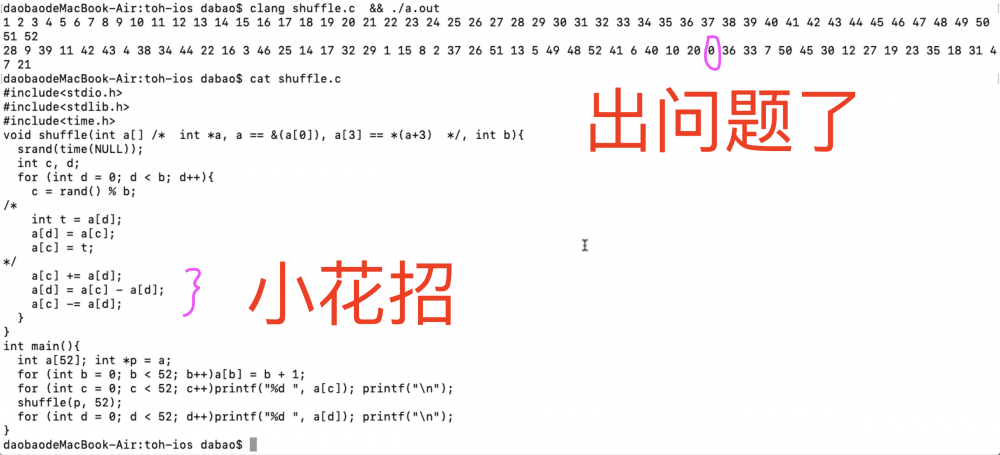
a[c] += a[d];
a[d] = a[c] - a[d];
a[c] -= a[d];
One day Lucas was implementing a card-shuffling algorithm.
A shuffle repeatedly swaps two positions in an array, representing two cards in a deck.
Everything appeared to work—except that occasionally one or more cards became zero.
A deck containing cards numbered 1 through 52 suddenly contained values that had never existed.
Replacing the clever swap with the ordinary temporary-variable version immediately fixed the problem.
The mystery was clear:
How can swapping two cards create a zero?
The answer appeared when we discovered that the shuffle sometimes selected the same position twice.
In other words:
c == d
The program was occasionally asking a card to swap places with itself.
At first this seemed harmless. If both values are 3, the arithmetic trick works perfectly:
a = 3;
b = 3;
But array elements introduce a deeper issue.
When c == d, the expressions a[c] and a[d] refer to the exact same memory location.
The code effectively becomes:
a[c] += a[c];
a[c] = a[c] - a[c];
a[c] -= a[c];
The middle line turns the value into zero.
The trick had not failed because the values were equal.
It failed because the two names referred to the same object.
The solution turned out to be wonderfully simple:
if (c == d) continue;
If a card is asked to swap with itself, do nothing.
This bug revealed a surprisingly deep idea:
Equal values are not the same thing as identical objects.
Two different cards can both contain the number 3.
But a card cannot exchange places with itself using a swap algorithm that assumes two independent locations.
Sometimes bugs teach concepts more effectively than lessons.
Lucas did not merely discover a bug.
He discovered the difference between value and identity.
A simple card shuffle can reveal an important computer science concept.
A rare edge case exposes the hidden assumptions inside a clever algorithm.
Understanding the difference between equal values and the same object is fundamental to programming.
Epilogue
Later, I shared this memorable story with Lucas's twin brother, Marius.
When Marius reached exactly the same point in his own program, he wrote:
coutinue;
The first n had somehow flipped upside down.
What made everyone laugh was that Lucas had made precisely the same mistake earlier.
Not approximately the same.
Not a similar typo.
The identical typo.
After all the discussions about variables, memory, and identity, the twins offered one final lesson:
Some things really do come in pairs.