When the Museum Learned to Update Itself
The museum had grown to dozens of exhibits, spanning learning stories, programming journeys, and personal moments.
Everything appeared complete from the outside:
MuseCoreStudio was publishing exhibits
Git was pushing content
The VM was pulling updates
A Python importer was transforming JSON into MySQL records
But there was a hidden gap:
new exhibits were not appearing in search.
The system looked alive, but was not fully synchronized.
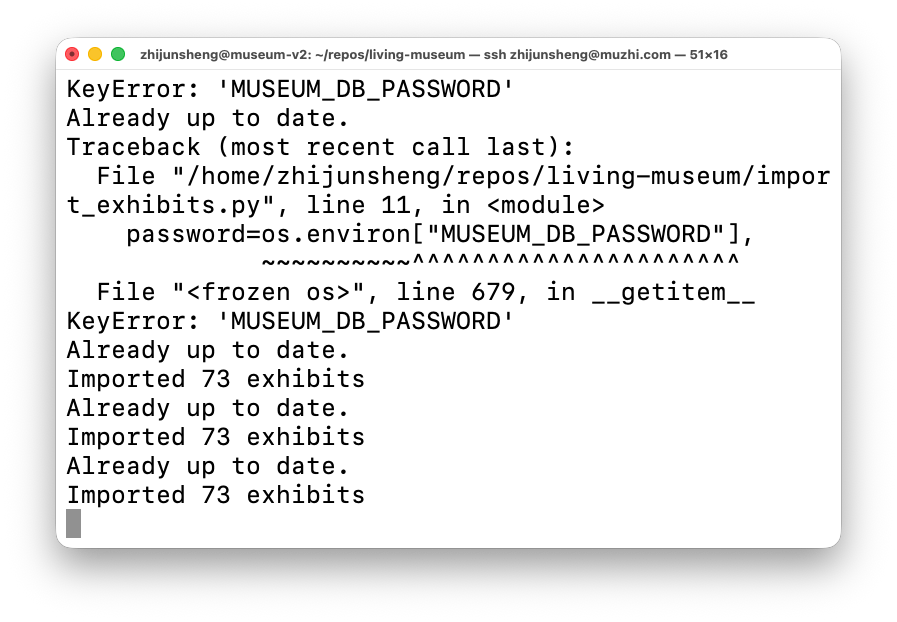
A small but critical error appeared in the logs:
KeyError: 'MUSEUM_DB_PASSWORD'
The cron job was running, but failing silently at the database connection stage.
This meant:
JSON files were being pulled correctly
The importer was being executed
But MySQL updates never completed
The pipeline was almost working — but not reaching the final step.
At first, the system appeared healthy and stable.
New exhibits were being created in MuseCoreStudio and pushed through Git. The VM was pulling updates and running the importer on schedule. Everything suggested continuity.
It was around this stage that we introduced automation:
a cron job was added to periodically pull the latest repository updates and run import_exhibits.py.
This was a quiet but important shift—from manual execution to a living, self-updating pipeline.
Shortly after automation began, a subtle issue appeared: the database always stopped at LM-0067.
That number initially felt arbitrary—just another boundary in a sequence. But it gradually became a subtle psychological marker in the debugging process. It was remembered, mentioned, and re-encountered repeatedly:
“It was always 67.”
Only later did we realize this was not coincidence, but the frozen state of the automated pipeline. The cron job was running, but failing silently due to a missing environment variable. As a result, the system never progressed beyond the last successful ingestion.
Once the missing MUSEUM_DB_PASSWORD was restored, the pipeline resumed. New exhibits—LM-0068, LM-0069, and beyond—began flowing into MySQL.
The number 67 quietly transformed from a limit into a timestamp of failure: not a technical constant, but a human memory of where automation stopped breathing.
And when the system finally moved past it, the museum did not just update.
It crossed a threshold it had been stuck behind without knowing.
The failure was not in logic, but in environment assumptions.
A system that works in an interactive shell may fail in automation because:
environment variables are not inherited
execution context is different
hidden dependencies become visible only in production-like conditions
More importantly:
A system is only as alive as its weakest missing assumption.
A personal learning museum can be fully automated end-to-end—from content creation to search—through a minimal but reliable infrastructure pipeline.
By explicitly managing environment context, separating secrets from code, and ensuring each stage of the pipeline is independently executable.
When content systems become self-updating, learning artifacts stop being static records and become living knowledge systems that continuously evolve.