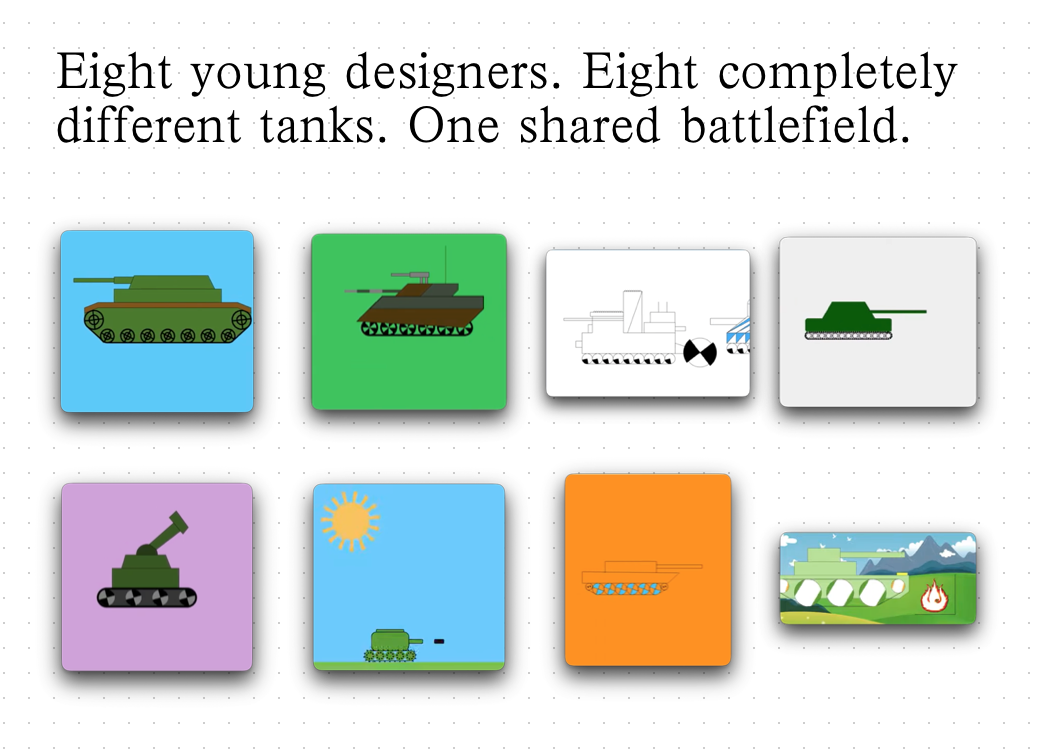
Inside the Tank Gallery
Several months after the Dream Team tank challenge began, the workshop gradually filled with moving machines. The original assignment was simple: Build a tank. But no two children interpreted the problem in the same way. Some focused on realism. Some emphasized motion. Some experimented with geometry. Some cared about details that adults would never notice.
As the animations arrived one by one, something surprising appeared. Although every student began from the same challenge, each tank developed its own personality. One had slanted tracks. One emphasized the wheels. One felt heavy and powerful. Another looked almost playful. The assignment was no longer: Can you build a tank? It became: What kind of designer are you?
Eight tanks entered the gallery. Each one moved differently. Each one revealed something about its creator. As the animations play, visitors may notice: different approaches to tracks and wheels different solutions to rotation and movement different aesthetic choices different levels of complexity different personalities expressed through code What appears on the screen is not merely machinery. It is seven children thinking.
When children build rather than consume, several things happen simultaneously:
mathematics becomes geometry programming becomes engineering design becomes personal expression competition becomes appreciation
The final voting was not simply about finding the "best" tank.
Two of the most technically ambitious students voted for one another.
The children recognized difficulty.
They recognized craftsmanship.
They recognized effort.