
Living Museum of Learning
Inside the Kite
Ivy continued developing her Tiling iOS project. What began as drawing geometric shapes gradually turned into a practical engineering problem: how can an app determine whether a user's finger touches a rotating kite?
Initial ideas such as rectangular or circular hit testing quickly proved unreliable because the kite rotates freely. Instead of testing the visible shape directly, Ivy introduced an inscribed rectangle that rotates together with the kite, creating a stable computational region for future touch detection.
The question changed from "Where is the finger?" to "Does this point belong to the transformed structure?" Geometry became more than drawing. Rotation, angle, and coordinate transformation became tools for defining behavior inside an interactive system.
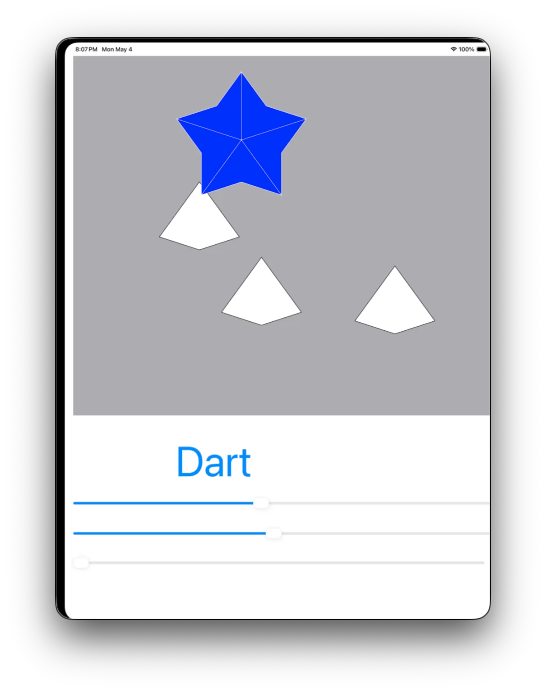
In her 13-second demonstration, three sliders control the kite's position and rotation while an internal rectangle remains aligned with the transformed geometry. Every vertex is derived from angles, lengths, and trigonometric relationships rather than fixed screen coordinates.
This project marks an important conceptual shift. Before, shapes were simply drawn on the screen. Now they become computational objects with measurable regions and predictable behavior.
Along the way, Ivy encountered several important engineering ideas:
• touch detection in rotated objects • geometric transformations • coordinate systems • hit-testing regions • interactive geometry • foundations of collision detection and game physics
The problem is no longer "Where is the finger?"
The problem becomes:
"Does this point belong to the transformed structure?"
Sometimes a small rectangle inside a kite opens the door to an entirely new way of thinking.